




What's Happening?
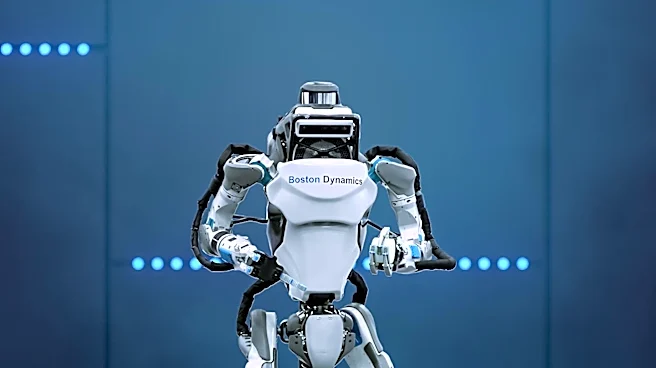
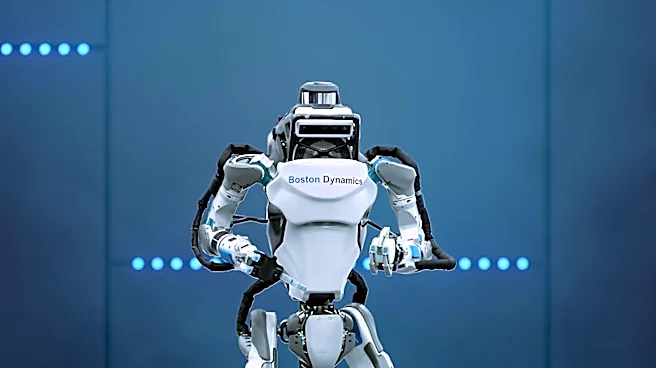
Boston Dynamics has released a video showcasing its Atlas humanoid robot performing a series of novel maneuvers, including rolling on wheels, sliding sideways, and executing a 360-degree jump. This demonstration is part of a research initiative aimed
at exploring how reinforcement learning can enhance robot movement, evaluate actuator performance, and bolster the reliability of control systems under demanding conditions. Engineers temporarily replaced Atlas's feet with wheels, utilizing custom adapters to attach commercially available scooter rims to the robot's existing ankle actuators. According to Xiaoyu (Andy) Wu, a controls engineer at Boston Dynamics, this wheeled Atlas is not a product but a research testbed. The project integrates traditional motor control engineering with whole-body reinforcement learning, a method that enables robots to develop movement strategies through extensive simulated training.
Why It's Important?
This research is crucial for advancing the capabilities and reliability of humanoid robots. By temporarily modifying Atlas with wheels, Boston Dynamics is able to test the robot's motors across a wide spectrum of speeds and torque demands. This allows for a more accurate evaluation of how behaviors learned in simulation translate to physical hardware, a critical step in closing the 'simulation-to-reality gap.' The findings from this project are already being applied to Atlas's standard bipedal configuration, with researchers focusing on improving its ability to respond to actuator failures and other unexpected operating conditions. Ultimately, this work aims to develop more robust control systems, which are essential for enabling humanoid robots to operate reliably and safely in complex, real-world environments, potentially impacting industries from logistics to disaster response.
What's Next?
The immediate next steps involve applying the insights gained from the wheeled Atlas experiments to improve the standard bipedal Atlas robot. Researchers are specifically working on enhancing Atlas's resilience to actuator failures and its adaptability to unforeseen operational challenges. The long-term objective is not to commercialize a wheeled version of Atlas, but rather to leverage this research to create more robust and reliable control systems for humanoid robots in general. This will pave the way for future generations of robots that can perform complex tasks with greater autonomy and safety in diverse settings. Continued development in reinforcement learning and simulation accuracy will be key to achieving these goals, potentially leading to breakthroughs in robotic dexterity and problem-solving capabilities.
Beyond the Headlines
The research into wheeled locomotion and advanced reinforcement learning for Atlas touches upon deeper implications for the future of robotics and artificial intelligence. The ability of robots to learn and adapt through millions of simulated scenarios, and then transfer those learned behaviors to physical hardware, represents a significant leap in AI development. This approach could lead to robots that are not only more efficient but also more resilient and capable of handling unpredictable situations, moving beyond pre-programmed movements. Ethically, as robots become more autonomous and integrated into daily life, the reliability and safety of their control systems become paramount. This research contributes to building that foundational trust, ensuring that future robotic systems can operate effectively and safely alongside humans, potentially transforming various sectors and societal interactions.