




What's Happening?
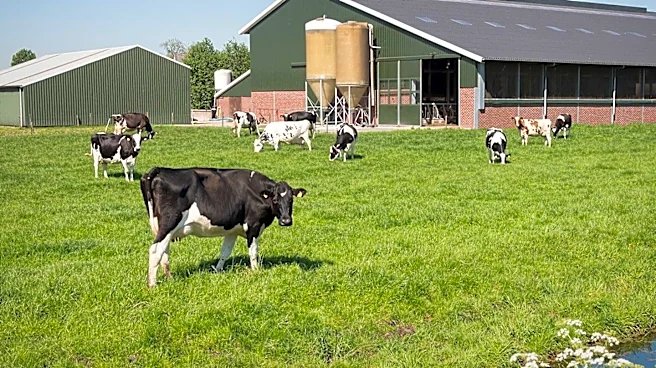
An exploratory study of twelve commercial pasture-based dairy farms in South Africa has revealed that operations generating higher financial margins per hectare simultaneously achieved larger net greenhouse gas removals. This finding challenges the conventional
assumption that livestock production inherently imposes an escalating net greenhouse gas burden. The study, published in Frontiers in Sustainable Food Systems, focused on farms along a 300-kilometer coastal belt in the Garden Route region. These farms managed grazing herds, primarily relying on perennial pastures supplemented with concentrates. Researchers utilized the DESTiny farm-scale systems model to estimate net greenhouse gas balances, accounting for enteric methane, manure management, soil nitrous oxide releases, and fuel and electricity emissions, alongside biogenic carbon fluxes in pasture soils and plant biomass. Eleven of the twelve investigated properties functioned as net greenhouse gas sinks over a single annual production cycle while maintaining positive operating margins, with an average net profit of USD 0.39 per kilogram of fat- and protein-corrected milk.
Why It's Important?
This research is significant as it demonstrates a viable pathway for the agricultural sector, particularly dairy farming, to achieve both economic profitability and environmental sustainability. The findings suggest that targeted agronomic strategies, such as conservation tillage, legume integration, calibrated nitrogen use, and balanced feed procurement, can enhance ecological and economic resilience simultaneously. This challenges the prevailing narrative that livestock production is solely a contributor to greenhouse gas emissions. For agricultural policymakers and commercial supply chain architects, the study highlights the inadequacy of relying solely on single-dimensional emission metrics. Instead, it advocates for multi-criteria frameworks that consider land area, livestock biomass, and saleable milk volume to properly evaluate sustainable intensification. The potential for carbon sequestration to act as a hypothetical cost reduction, bolstering operating profits, could incentivize broader adoption of these practices.
What's Next?
While the study provides encouraging results, the researchers emphasize that the modeled annual fluxes do not carry permanence guarantees and cannot be commercialized under compliance or voluntary offset standards without standardized multi-year physical verification protocols. Extensive infrastructural development and physical soil sampling frameworks would be required to remunerate these modeled annual fluxes as verified ecosystem services. Future research will need to address these methodological and structural limitations, including capturing inter-annual climatic shocks, pasture yield oscillations, and macroeconomic price volatility. The findings, however, lay the groundwork for developing policies and incentives that support the adoption of integrated agronomic bundles, which combine high dry matter forage yields with conservation tillage and nitrogen-fixing legumes, to achieve both economic and environmental benefits in the dairy sector.
Beyond the Headlines
The study's implications extend beyond the immediate agricultural sector, offering a potential paradigm shift in how the environmental impact of livestock farming is perceived and managed. By demonstrating that certain farming practices can lead to net carbon removals while remaining profitable, it provides a counter-narrative to the often-criticized environmental footprint of animal agriculture. This could influence consumer perceptions, investment decisions in sustainable agriculture, and the development of carbon markets that include agricultural sequestration. The emphasis on land productivity as a key driver for both profitability and carbon removal suggests that efficient land use is crucial for sustainable food systems. This approach could also inspire similar studies and initiatives in other regions and agricultural sectors, fostering a more holistic understanding of agriculture's role in climate change mitigation.