



What's Happening?
The Taiwan Institute of Economic Research (TIER) has increased its forecast for Taiwan's economic growth in 2026 to 12.34 percent, up from its previous estimate of 10.38 percent in July. This upward revision is primarily attributed to the robust demand
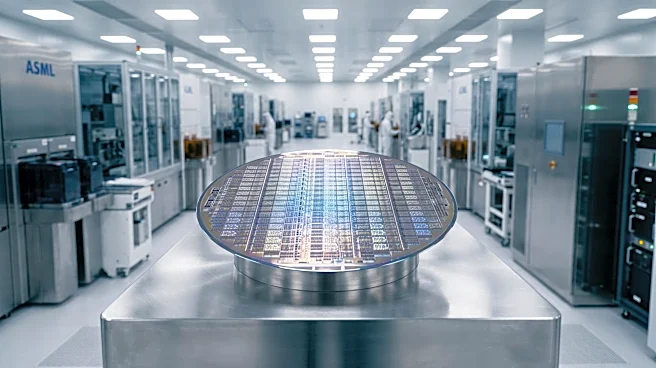
for artificial intelligence (AI) hardware, which has significantly boosted Taiwan's exports and investment. Global spending on AI infrastructure has fueled the demand for Taiwan-made chips and servers, prompting manufacturers to expand their production capacity and acquire more equipment. TIER now anticipates exports of goods and services to grow by 23.75 percent this year, with private investment expected to rise by 13.17 percent. TIER President Chang Chien-yi noted that earlier forecasts did not fully account for the 'AI arms race' and the rapid advancement of AI technology. The institute projects Taiwan's semiconductor output to increase by 21.5 percent in value next year, reaching a record NT$11.8 trillion, driven by AI demand and expanded capacity in advanced chipmaking and packaging.
Why It's Important?
This revised forecast from TIER underscores the profound global economic impact of the AI boom, particularly on key players in the semiconductor supply chain like Taiwan. The surge in demand for AI hardware directly benefits U.S. technology companies that rely on these components for their products and services, from data centers to consumer electronics. It also highlights the critical role Taiwan plays in the global technology ecosystem, as its increased output of chips and servers is essential for meeting worldwide AI infrastructure needs. For U.S. businesses, this sustained demand could lead to more stable supply chains for AI-related components, but also potentially increased competition for these vital resources. The expansion of manufacturing capacity in Taiwan could also influence U.S. policy discussions regarding domestic semiconductor production and supply chain resilience, given the strategic importance of these technologies.
What's Next?
TIER forecasts that while growth in exports and private investment will continue into 2027, it is expected to slow down after this year's rapid surge, with GDP growth projected at 6.45 percent. Continued demand for AI hardware is anticipated to support exports and investment, albeit at a more moderate pace. Spending by major cloud service providers is expected to keep rising, though potentially at a slower rate due to higher data center construction and financing costs, and uncertainties regarding the revenue generation from AI investments. Two major uncertainties for 2027 identified by TIER include the sustained strength of AI demand and the resolution of geopolitical conflicts. Restrictions on data center development in certain U.S. states could also shift projects, but the overall strength of demand remains the primary concern for Taiwan's suppliers. The petrochemical sector, however, faces a weaker outlook due to price competition from China and higher environmental compliance costs, despite some support from demand for chemicals used in chipmaking.
Beyond the Headlines
The 'AI arms race' mentioned by TIER President Chang Chien-yi suggests a competitive global landscape where nations and corporations are vying for technological supremacy in AI. This competition has significant implications for U.S. national security and economic policy, as access to advanced AI hardware becomes a strategic imperative. The concentration of advanced chip manufacturing in Taiwan also raises questions about supply chain vulnerabilities and the need for diversification, a concern that has already prompted significant investment and policy initiatives in the U.S. to boost domestic semiconductor production. The potential for data center development restrictions in U.S. states to shift projects elsewhere highlights the complex interplay between local regulations, global demand, and the strategic location of critical infrastructure. This dynamic could lead to a re-evaluation of incentives and regulatory frameworks to ensure the U.S. remains competitive in attracting and retaining AI infrastructure investments.