




What's Happening?
The Rehmann Museum is set to host a unique dialogue event titled 'Das Verborgene begreifen' (Grasping the Hidden) on November 15. This event will explore the interplay of knowledge, tactile perception, and speculation in archaeological research. The discussion
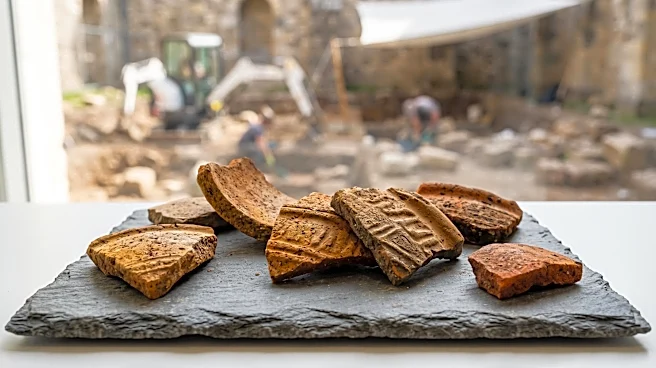
will feature the Aargau Cantonal Archaeology department and Stefan Rehmann, a psychotherapist and blind expert. Rehmann, who resides in the former home of Erwin Rehmann, aims to make art perception through touch accessible to a wider audience. The event will delve into how archaeologists use minimal clues to 'see' hidden objects in the ground and how the sense of touch is crucial in determining and dating fragmented ceramic vessels by assessing material properties and clay tempering. This method provides insights into manufacturing techniques and chronological classification.
Why It's Important?
This event is significant as it bridges the gap between the haptic experience of blind individuals and the scientific methodology of archaeology, particularly in dealing with incomplete information. By highlighting the role of touch in archaeological discovery, it challenges the conventional reliance on visual perception in scientific fields. Stefan Rehmann's participation as a blind art enthusiast and psychotherapist underscores the potential for diverse perspectives to enrich scientific understanding and public engagement. The discussion's focus on the speculative nature of archaeology—how interpretations can evolve and be refined—emphasizes that scientific knowledge is not static but a dynamic process of exploration and re-evaluation. This approach can foster a more inclusive understanding of both art and science, demonstrating how different sensory experiences contribute to knowledge acquisition.
What's Next?
The dialogue event at the Rehmann Museum is scheduled for November 15. Attendees will have the opportunity to engage with the Aargau Cantonal Archaeology and Stefan Rehmann on the themes of tactile perception and archaeological research. The event includes an exhibition entry, with an option for a public guided tour beforehand. The museum aims to continue fostering discussions that connect diverse fields and perspectives, particularly those that highlight alternative ways of experiencing and understanding the world. This initiative could inspire similar programs in other cultural and scientific institutions, promoting accessibility and interdisciplinary dialogue.
Beyond the Headlines
The event at the Rehmann Museum touches upon deeper implications regarding the nature of perception and knowledge. It suggests that understanding is not solely dependent on sight but can be profoundly shaped by other senses, such as touch. This has ethical and cultural dimensions, as it promotes inclusivity for individuals with visual impairments in fields traditionally dominated by visual methods. The discussion about how a blind person reconstructs an object through touch and memory, and how this can sometimes lead to misinterpretations, mirrors the scientific process where initial hypotheses are constantly tested and refined. This highlights the inherent uncertainty and dynamic nature of knowledge acquisition, whether in archaeology or everyday life, encouraging a more nuanced appreciation of how we come to understand our world.