





What's Happening?
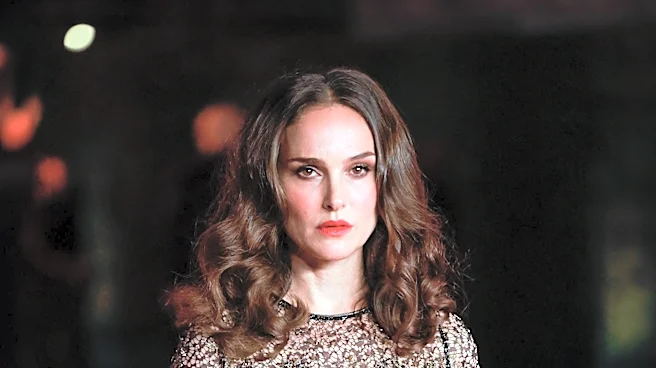
Rachel Cusk's new novel, 'Life of M,' delves into the life of a celebrated film actor named M, whose career trajectory bears a striking resemblance to that of Natalie Portman. The narrative highlights instances such as M's first film having sex scenes
cut at her mother's insistence, mirroring Portman's debut in 'Leon,' and a ballerina movie that is recognizably 'Black Swan.' The novel, which evolved from a short story published in The New Yorker, explores the complexities of fame, the blurring lines between pretense and reality, and the impact of celebrity on personal life. The story is told through the perspective of a nameless narrator who initially proposes writing M's autobiography, leading to an exploration of authenticity and performance in the public eye. Cusk's prose is noted for its sharp, spare quality and precise observations.
Why It's Important?
This novel is important for its critical examination of celebrity culture and the human experience within it. By drawing parallels to a real-life figure like Natalie Portman, Cusk prompts readers to consider the constructed nature of public personas and the challenges faced by individuals who have lived their lives in the spotlight. The themes of authenticity versus performance, and the corrosive effects of fame on personal relationships, resonate broadly in a society increasingly shaped by social media and constant public scrutiny. The novel's exploration of these themes offers a nuanced perspective on the psychological toll of celebrity, making it relevant to discussions about mental health, privacy, and the societal impact of media representation. It challenges readers to reflect on their own perceptions of reality and the narratives they consume.
Beyond the Headlines
Beyond the immediate narrative of a celebrity's life, 'Life of M' touches upon deeper philosophical questions about identity and existence in the modern age. Cusk's assertion that 'character doesn't exist anymore' in her previous work, while seemingly contradicted by the detailed portrayal of M, suggests a broader commentary on how external pressures and public expectations can fragment or obscure an individual's true self. The novel's meticulous descriptions of settings, akin to stage directions, further emphasize the idea that life, particularly for the famous, can feel like a performance. This raises ethical considerations about the consumption of celebrity narratives and the responsibility of both creators and audiences in shaping these perceptions. The book encourages a critical look at the societal mechanisms that create and sustain fame, and the often-unseen human cost involved.