




What's Happening?
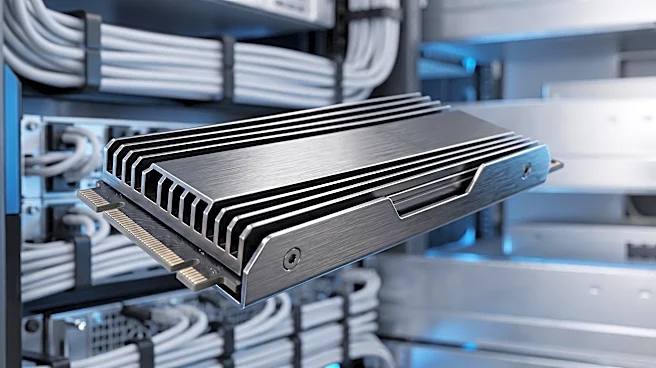
Broadcom, through its VMware product portfolio, has introduced Memory Tiering in VMware Cloud Foundation (VCF) 9.1, a significant innovation aimed at extending host memory using NVMe (Non-Volatile Memory Express) devices alongside traditional DRAM (dynamic
random access memory). This feature creates a single logical memory space that virtual machines (VMs) can utilize transparently, without needing to know which memory tier their pages reside on. Unlike traditional swapping, which is a reactive measure when memory is exhausted, Memory Tiering operates proactively and continuously in the background. It scans VM memory pages, classifying them as 'hot' (frequently accessed) or 'cold' (rarely accessed) based on recency and frequency signals. Hot pages remain in the faster DRAM (Tier 0), while cold pages are migrated to the NVMe-based Tier 1, optimizing memory usage and performance.
Why It's Important?
Memory Tiering in VMware Cloud Foundation 9.1 is crucial for U.S. businesses as it addresses the escalating costs and physical limitations of DRAM, a critical component in data centers. By intelligently utilizing NVMe devices, organizations can significantly extend their effective memory capacity without incurring the high expenses of additional DRAM. This innovation allows for greater VM consolidation on fewer hosts, leading to reduced power consumption, cooling requirements, and overall management overhead. For businesses, this translates into a lower total cost of ownership (TCO) per VM and provides headroom for growth without a proportional increase in hardware expenditure. The ability to maintain high performance for active workloads while efficiently managing less frequently accessed data is a key advantage, particularly for memory-intensive applications like databases.
What's Next?
Organizations adopting VMware Cloud Foundation 9.1 will need to strategically implement Memory Tiering, considering their specific workload patterns and hardware configurations. The default configuration uses a 1-to-1 DRAM-to-NVMe ratio, up to a maximum of 4 TB of NVMe tiering capacity, offering a starting point for deployment. Businesses with workloads characterized by a significant amount of 'cold' memory stand to benefit most from this feature, potentially achieving substantial cost savings and performance improvements. IT professionals will need to monitor and adjust their tiering strategies to ensure optimal performance and resource utilization. The success of Memory Tiering will likely encourage further innovation in memory management technologies within the virtualization space, pushing the boundaries of efficiency and cost-effectiveness in data centers.
Beyond the Headlines
The introduction of Memory Tiering represents a fundamental shift in how virtualized environments manage memory resources, moving beyond reactive swapping to a proactive, intelligent system. This approach not only optimizes hardware utilization but also contributes to environmental sustainability by enabling greater consolidation and reducing the energy footprint of data centers. The underlying principle of classifying data based on access patterns (hot vs. cold) has broader implications for data management strategies across various IT domains, potentially influencing future designs of storage and computing architectures. This technology underscores the ongoing effort to maximize the value of existing hardware investments while preparing for the increasing demands of modern applications and data volumes, fostering a more efficient and responsive digital infrastructure.