






What's Happening?
The Fraunhofer IWM research institute has initiated the ORka3D project, funded by Germany’s Federal Ministry for Economic Affairs and Energy (BMWE), to significantly reduce steel usage in welded structures. This initiative combines 3D scanning and artificial
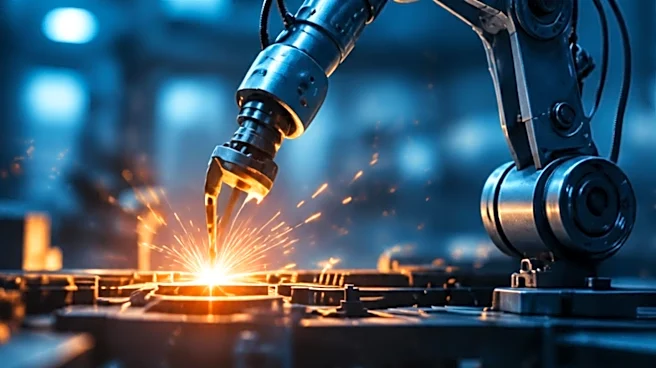
intelligence to improve the assessment of weld seams and predict fatigue more accurately. Currently, structures like offshore wind towers and excavator arms are often over-engineered with excess steel due to conservative design rules that assume worst-case weld geometries. The new method involves digitally measuring weld surfaces with high-resolution 3D scanners, capable of pixel distances up to 5 microns. An algorithm then extracts critical geometric parameters, such as the weld toe radius, which are not covered by current standards. This data is fed into a neural network to determine a joint's individual notch factor and predict its fatigue life. The approach has been validated on approximately 400 specimens and real-world structures, demonstrating its potential to optimize material use by objectively capturing and evaluating the unique geometry of each weld.
Why It's Important?
This project holds significant implications for heavy industries and renewable energy sectors by enabling substantial material savings and reducing environmental impact. For instance, researchers estimate that better weld assessment could remove around 180 tons of steel from a 600-ton offshore wind turbine tower. If applied across Germany's planned 30 gigawatts of offshore capacity by 2030, this could save 360,000 tons of steel and millions of tons of CO2 emissions. Beyond wind energy, bridge building and construction machinery industries also stand to benefit from this technology. The current practice of over-engineering due to imprecise weld quality assessment leads to unnecessary material consumption and increased costs. By providing a more precise and objective evaluation of weld integrity, the ORka3D project can lead to more efficient designs, lower production costs, and a reduced carbon footprint across various critical infrastructure projects, benefiting both manufacturers and the environment.
What's Next?
The ORka3D method is currently in the demonstrator stage, with key industry partners like Liebherr and Volvo Construction Equipment actively working to integrate it into regulatory frameworks. The next steps involve further refinement of the technology and its standardization to ensure widespread adoption. As AI analysis of scan data continues to mature, this approach is expected to influence not only how welded structures are inspected but also how they are designed from the outset. The collaboration with major manufacturers indicates a strong industry interest in implementing these advancements, suggesting that the technology could soon transition from research to practical application, leading to updated design rules and manufacturing processes in the coming years. The goal is to establish new industry standards that leverage precise digital measurements and AI-driven fatigue predictions.
Beyond the Headlines
The development of this technology signifies a broader trend towards integrating advanced digital tools and artificial intelligence into traditional engineering and manufacturing processes. It highlights a shift from conservative, generalized design assumptions to data-driven, individualized assessments, which can unlock efficiencies previously unattainable. Ethically, this approach promotes more sustainable industrial practices by minimizing waste and resource consumption. Legally, its integration into regulatory standards will require updates to existing codes and certifications for welded structures, potentially setting new benchmarks for safety and material efficiency. Culturally, it represents a move towards greater precision and automation in quality control, reducing reliance on subjective human assessment and fostering a more data-centric engineering culture. This could lead to long-term shifts in how materials are specified, how structures are designed, and how quality assurance is performed across heavy industries globally.