




What's Happening?
Take-Two Interactive Software, Inc. (TTWO), a New York-based developer and publisher of interactive entertainment solutions, has seen its stock decline by 10.8% over the past year, significantly underperforming the S&P 500 Index, which gained nearly 5.7%
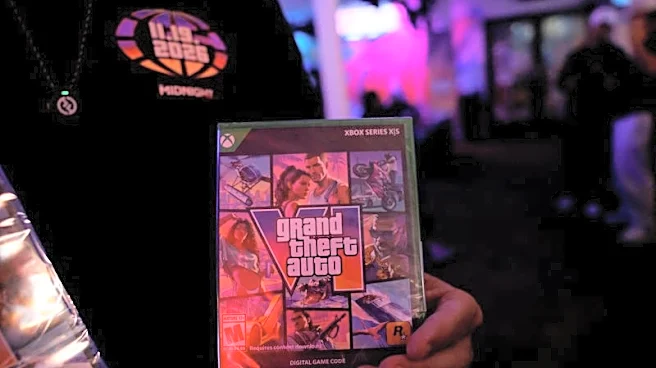
in the same period. In 2026 alone, TTWO's stock fell 18%, while the S&P 500 rose 1%. The company, with a market capitalization of $39.3 billion, develops popular franchises such as Grand Theft Auto and NBA 2K. This underperformance is attributed to several factors, including investor concerns over pre-launch execution and potential delays for Grand Theft Auto VI, ongoing GAAP net losses, substantial development and operating costs, and a softer reception for titles like NBA 2K27. Despite these challenges, Grand Theft Auto VI achieved record-breaking entertainment launch sales upon its debut on November 19, 2026. On November 9, TTWO shares dropped 3.5% after its Q2 results showed adjusted EPS of $1, exceeding Wall Street expectations of $0.90, but revenue of $1.6 billion fell short of the $1.7 billion forecast.
Why It's Important?
The underperformance of a major interactive entertainment company like Take-Two Interactive, despite strong analyst predictions and a blockbuster game launch, highlights the complex dynamics within the video game industry. The significant decline in TTWO's stock compared to the broader market indicates that even successful product launches may not immediately translate into sustained investor confidence if other financial metrics, such as revenue forecasts and ongoing costs, present concerns. This situation impacts not only Take-Two Interactive but also potentially influences investor sentiment across the broader entertainment software sector. The mixed financial results, with EPS beating expectations but revenue falling short, underscore the challenges companies face in managing investor expectations while navigating high development costs and the cyclical nature of game releases. The disparity between the stock's performance and the S&P 500's growth suggests that investors are scrutinizing the long-term profitability and operational efficiency of gaming companies more closely, even those with highly anticipated titles.
What's Next?
Analysts maintain a "Strong Buy" consensus for Take-Two Interactive, projecting an 88.7% EPS growth to $5.19 by March 2027. The company anticipates full-year adjusted EPS to range from $0.57 to $0.75, with revenue expected to be between $8 billion and $8.2 billion for the fiscal year ending March 2027. Investors will closely monitor the company's ability to meet these financial targets, particularly in light of its recent revenue shortfall and ongoing development costs. The performance of Grand Theft Auto VI in the coming quarters will be crucial for the company's financial outlook and investor confidence. Future earnings reports will provide further insight into whether the strong sales of its flagship title can offset other operational challenges and lead to a recovery in stock performance. The company's strategy for managing development costs and improving the reception of other titles, such as NBA 2K, will also be key factors in its future trajectory.
Beyond the Headlines
The situation with Take-Two Interactive reflects a broader trend in the entertainment industry where the success of a single, highly anticipated product can overshadow underlying financial complexities. While Grand Theft Auto VI's record-breaking launch demonstrates the immense demand for high-quality interactive entertainment, the company's overall stock performance suggests that investors are looking beyond individual product successes to evaluate the company's holistic financial health and operational efficiency. This highlights the increasing pressure on gaming companies to not only deliver popular titles but also to manage development cycles, control costs, and diversify their revenue streams effectively. The mixed earnings surprise history, where EPS beat expectations but revenue missed, points to potential challenges in forecasting and managing the financial outcomes of large-scale game development. This could lead to a re-evaluation of investment strategies within the gaming sector, with a greater emphasis on consistent financial performance rather than solely relying on the hype surrounding major releases.