






What's Happening?
China's Customs Tariff Commission announced on November 9, 2026, an extension of the suspension of the 24% additional tariff on U.S.-origin goods for another two months. This measure, effective November 10, 2026, maintains the existing trade landscape
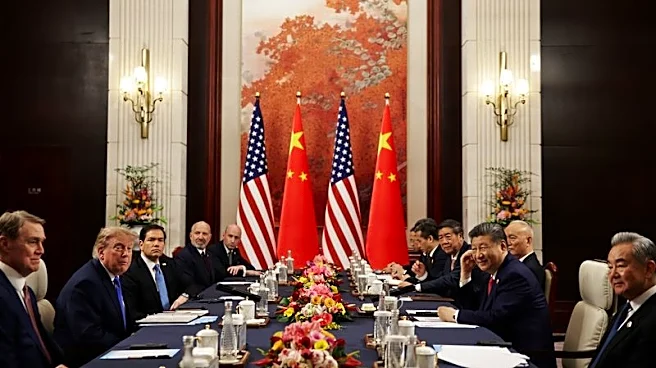
where a 10% additional tariff continues to apply, while the 24% component remains suspended. This decision follows a videoconference on November 6, 2026, between U.S. and Chinese trade officials, where U.S. Trade Representative Jamieson Greer emphasized China's need to fulfill existing commitments, particularly concerning agricultural purchases, rare earths, and other critical minerals. The original additional tariffs were imposed in April 2025. Alongside the tariff extension, China also prolonged the suspension of special port-fee regimes for U.S. vessels and measures related to several U.S. entities on China's export control list and Unreliable Entity List. The Tariff Commission indicated it would monitor U.S. actions regarding potential shifts in tariff imposition methods and adjust its countermeasures accordingly.
Why It's Important?
This extension provides a temporary reprieve for businesses involved in U.S.-China trade, offering continued stability regarding tariff rates for U.S.-origin goods imported into China. The ongoing suspension of the 24% tariff component, while the 10% remains, allows companies to plan their supply chains and pricing strategies without the immediate threat of a significant tariff increase. However, the temporary nature of the extension, running until approximately January 10, 2027, introduces uncertainty for long-term planning. Businesses must assess their tariff exposure and review contractual arrangements to account for potential changes after the suspension period. The discussions between USTR Jamieson Greer and Chinese officials highlight the persistent trade tensions and the U.S.'s focus on China's adherence to trade commitments, indicating that the broader trade relationship remains a critical area of negotiation and potential friction.
What's Next?
Businesses engaged in U.S.-China trade should closely monitor developments as the two-month suspension period approaches its end around January 10, 2027. The Tariff Commission's statement about monitoring U.S. actions regarding potential shifts from International Emergency Economic Powers Act (IEEPA) tariffs to Section 301 tariffs suggests that China's future tariff decisions will be influenced by U.S. trade policy adjustments. This could lead to corresponding adjustments in China's tariff countermeasures. Stakeholders should prepare for potential scenarios where the suspended 24% tariff could be reinstated or further modified. Continued dialogue between U.S. and Chinese trade officials, particularly involving USTR Jamieson Greer, will be crucial in shaping the future of these trade measures and could lead to further extensions, modifications, or escalations of tariffs and related trade restrictions.
Beyond the Headlines
The ongoing, albeit temporary, suspension of tariffs reflects a delicate balancing act in the U.S.-China trade relationship, where both nations seek to manage economic impacts while asserting their trade interests. The emphasis by USTR Jamieson Greer on China's existing commitments, especially concerning critical sectors like agriculture and rare earths, underscores the strategic importance of these goods in global supply chains and national security. The potential shift in U.S. tariff imposition methods, from IEEPA to Section 301, could signal a more permanent or structurally different approach to trade enforcement, which China is closely watching. This dynamic interplay of temporary measures and strategic posturing highlights the complex, evolving nature of international trade policy, where economic considerations are intertwined with geopolitical objectives and long-term industrial strategies.