







What's Happening?
The Metals Company (TMC) is pursuing deep-sea mining operations to secure critical minerals for the U.S., aiming to reduce reliance on Chinese supplies. TMC is seeking regulatory approval to commence commercial mining in the Pacific Ocean. The U.S. is not
a party to the UN Convention on the Law of the Sea (UNCLOS) and is not a voting member of the International Seabed Authority (ISA), which regulates international waters. Instead, the U.S. relies on the Deep Seabed Hard Mineral Resources Act (DSHMRA), authorizing the National Oceanic and Atmospheric Administration (NOAA) to issue deep-sea exploration licenses and commercial recovery permits to U.S. corporations in international waters. TMC is targeting a production volume of 3 million wet tonnes of polymetallic nodules per year, with plans to expand to 10.8 million wet tonnes per year by 2031. The company projects potential revenues of $369 billion and over $200 billion in EBITDA over the project's lifespan.
Why It's Important?
The U.S. dependence on foreign sources for critical minerals, particularly from China, poses significant national security and economic risks. TMC's deep-sea mining initiative could provide a domestic source for these essential materials, crucial for modern technologies. However, the lack of established regulatory precedent for deep-sea mining and the U.S.'s non-participation in UNCLOS create a complex legal and operational environment. The success of TMC's venture could set a precedent for future deep-sea mining operations, influencing international law and resource extraction policies. The high capital costs and technological challenges associated with operating in extreme deep-ocean environments also highlight the significant investment and innovation required to achieve this independence. The outcome will impact the U.S.'s strategic mineral supply chain and its position in the global technology landscape.
What's Next?
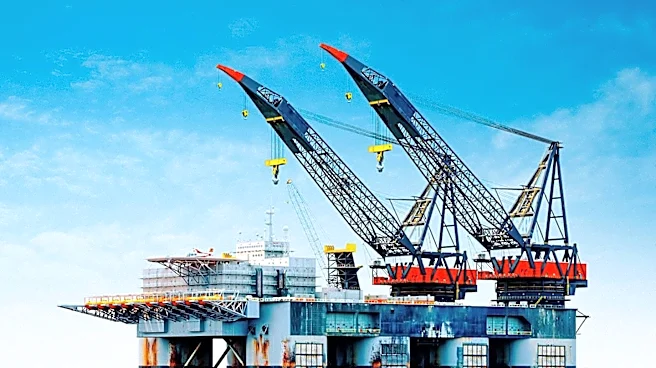
TMC is awaiting final approval from NOAA for its deep-sea commercial mining permit, with the regulatory review expected to conclude by the first quarter. The company hopes to begin commercial mining as early as the fourth quarter of 2027. TMC's partner, Allseas, has redesigned the offshore system to utilize two subsea collector vehicles alongside the Hidden Gem production vessel, aiming to achieve the target of 3 million wet tonnes per year. Investors are closely monitoring the 'wet tonnes per year' metric as a key indicator of the company's progress and viability. The successful launch and scaling of TMC's operations could significantly impact the availability and cost of critical minerals in the U.S., potentially leading to further investments in deep-sea exploration and extraction technologies.
Beyond the Headlines
The pursuit of deep-sea mining by companies like TMC raises profound ethical and environmental questions. The deep ocean is a largely unexplored ecosystem, and the potential ecological impact of large-scale mining operations is not fully understood. Concerns include habitat destruction, disruption of marine life, and the long-term effects on ocean biodiversity. The U.S.'s reliance on its own Deep Seabed Hard Mineral Resources Act, rather than UNCLOS, could lead to international disputes over resource rights and environmental standards in international waters. This situation underscores a broader tension between economic necessity, technological advancement, and environmental stewardship, potentially shaping future international agreements on resource governance and conservation.