







What's Happening?
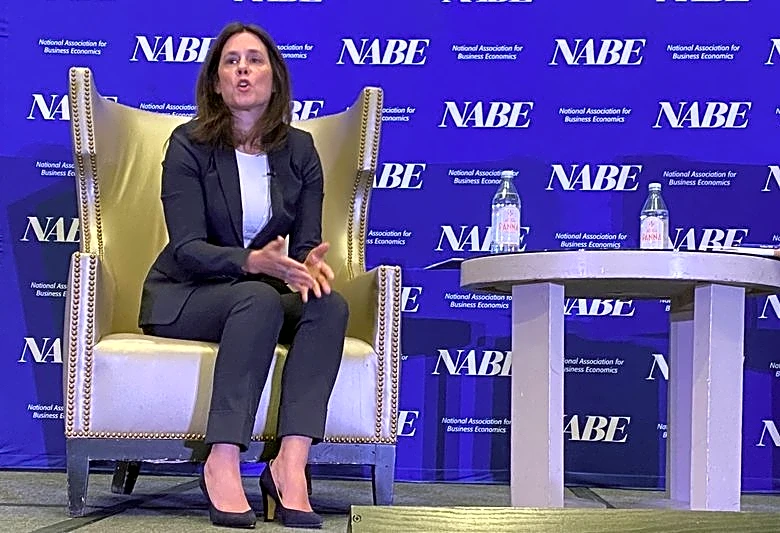
Janet Henry, HSBC's global chief economist, has warned that global economic growth faces increasing risks in 2027 due to fading fiscal stimulus, rising energy costs, and persistent inflation. Speaking at the Clearstream Global Fund Summit, Henry highlighted
that fiscal support, including U.S. federal spending, which sustained growth through 2026, is expected to diminish. This withdrawal of government support, coupled with geopolitical disruptions in the Strait of Hormuz driving up energy prices, is squeezing household disposable incomes and limiting central banks' ability to maneuver. While corporate investment in AI has emerged as an offset, particularly in the UK, the crucial question remains whether this momentum can continue as public spending slows. Henry also noted that government debt in many advanced economies exceeds 100% of GDP, with states betting on AI-driven productivity growth to manage these burdens, a bet she described as 'unwritten.'
Why It's Important?
This outlook has significant implications for the U.S. economy. The anticipated fading of fiscal stimulus, including U.S. federal spending, suggests a potential slowdown in economic growth. The debate over the debt ceiling in the U.S. is also expected to dominate fiscal policy, adding another layer of uncertainty. If corporate investment in AI does not sufficiently compensate for reduced public spending, the U.S. could see a weakening of its economic resilience. Furthermore, the reliance on productivity growth from AI to manage sovereign debt poses a substantial risk. If AI primarily replaces jobs rather than enhancing them, U.S. government revenues, which are heavily dependent on employment income, could face severe shortfalls, impacting public services and fiscal stability. The concentration of equity ownership among older U.S. households also makes consumer spending vulnerable to asset market pullbacks.
What's Next?
In the U.S., the debate over the debt ceiling will be a critical determinant of fiscal policy in 2027, potentially influencing the extent of any further fiscal support. Central banks, including the Federal Reserve, are expected to continue navigating a high-inflation environment, with further interest rate increases possible to preserve price stability, albeit at the risk of a sharper economic slowdown. Businesses will likely continue to invest in AI, but the effectiveness of these investments in driving productivity and offsetting reduced public spending will be closely watched. Governments will also need to consider potential reforms to tax systems, which are currently heavily reliant on employment income, to adapt to a future where AI may alter the labor market landscape. The 'no hire, no fire' trend in the U.S. labor market suggests companies may remain cautious about workforce expansion.
Beyond the Headlines
The warning from HSBC's chief economist points to a fundamental shift in the drivers of global economic growth, moving from fiscal stimulus to a greater reliance on technological innovation, specifically AI. This transition carries inherent risks, particularly regarding the uncertain impact of AI on productivity and employment. The fiscal challenge extends beyond immediate debt burdens to the long-term sustainability of government revenues in an AI-transformed economy. If AI leads to widespread job displacement without adequate new job creation or revenue streams, it could necessitate a re-evaluation of social safety nets and taxation models. The concentration of wealth in older demographics in the U.S. also highlights a generational economic vulnerability, where a market downturn could disproportionately affect consumer spending and overall economic health, potentially exacerbating intergenerational inequalities.