




What's Happening?
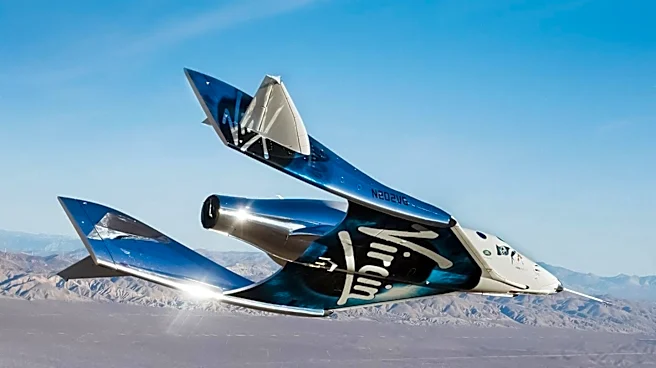
Virgin Galactic is positioning itself as a leader in 'human-first' commercial spaceflight, targeting high-net-worth individuals, researchers, and government clients. The company's initial operational spacecraft, VSS Unity, completed several commercial flights
before operations were paused in 2024. This pause is to allow the company to focus on developing its next generation of vehicles, the Delta Class spaceships. These new spacecraft are designed to carry six passengers, an increase from previous models, and are intended to fly with significantly greater frequency. Virgin Galactic's business model centers on selling seats for suborbital spaceflights, offering a comprehensive experience that includes training and flight preparation. The company also generates revenue by transporting research payloads for scientific institutions and government agencies, providing microgravity experiment opportunities. Virgin Galactic operates primarily from Spaceport America in New Mexico and utilizes a unique air-launch system where a 'mothership' carrier aircraft lifts the rocket-powered spaceship to altitude before release.
Why It's Important?
Virgin Galactic's advancements in commercial spaceflight are significant for the emerging space tourism industry and broader commercial space economy. By developing the Delta Class spaceships, the company aims to improve its unit economics and achieve greater scale, which could make suborbital space travel more accessible, albeit still for a niche market. The focus on increased flight frequency and passenger capacity is crucial for transitioning from a developmental-stage business to a more commercially viable operation. The company's strategy to serve both private individuals and scientific/government clients diversifies its revenue streams and underscores the growing utility of commercial space platforms beyond tourism. Success in this endeavor could further validate the private sector's role in space exploration and open new avenues for research and development in microgravity environments, potentially fostering innovation across various scientific fields.
What's Next?
Virgin Galactic's immediate next step involves the continued development, testing, and certification of its Delta Class spaceships. The company's future financial performance and market position heavily depend on the successful deployment and operational frequency of these new vehicles. As the company is currently pre-profit and incurring significant losses, the ability to scale operations with the Delta Class fleet is critical for achieving profitability and sustaining its business. Investors will be closely watching for updates on the development timeline, flight test results, and the commencement of commercial operations with the new spacecraft. Additionally, the company will need to manage its substantial customer backlog and convert reservations into completed flights to recognize revenue. The evolving regulatory landscape for commercial human spaceflight, particularly from agencies like the U.S. Federal Aviation Administration, will also play a role in shaping future operations and potential expansion.
Beyond the Headlines
The pursuit of commercial human spaceflight by companies like Virgin Galactic represents a broader shift in how humanity engages with space. Beyond the immediate economic implications, this development touches upon ethical considerations regarding access to space, environmental impacts of increased space launches, and the long-term vision for human presence beyond Earth. The 'human-first' approach emphasizes the experiential aspect of space travel, potentially fostering a new cultural appreciation for space. Furthermore, the integration of research payloads into commercial flights could democratize access to space-based scientific experimentation, allowing a wider range of institutions and researchers to conduct studies in microgravity. This commercialization also raises questions about the future role of government space agencies, potentially shifting them towards oversight and foundational research while private entities drive operational aspects of space access and tourism.