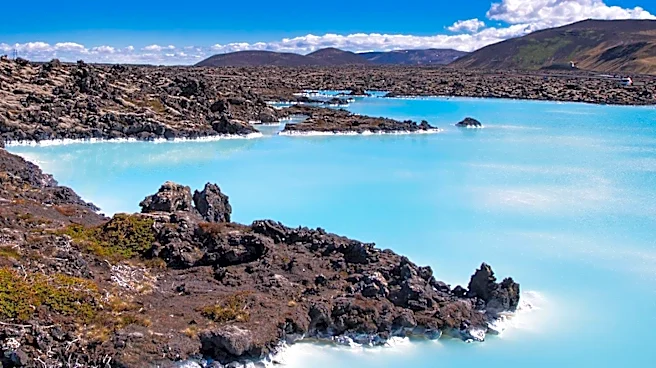








What's Happening?
Shareholders of Bláa Lónið hf., the company operating Iceland's renowned Blue Lagoon, have approved plans for a public share offering and an application to list on Nasdaq Iceland's Main Market. The listing is targeted for November 2026, marking a revival
of plans previously postponed due to volcanic emergencies near Grindavík. While final terms, valuation, and the precise timetable are yet to be disclosed and remain subject to Nasdaq's review, this move aims to provide investors with direct exposure to one of Iceland's most recognized tourism brands. The Blue Lagoon's operations have expanded beyond its geothermal spa to include hotels, restaurants, skincare products, wellness services, and destination development. Concurrently, Samskip, an Iceland-founded logistics company, is set to be acquired by Spain's Boluda Shipping, a transaction expected to finalize by January 1, 2027, pending regulatory approvals. This acquisition will integrate Samskip's maritime and intermodal network, connecting the Nordic countries with continental Europe, into a larger European shipping group.
Why It's Important?
The Blue Lagoon's IPO is a significant test of investor confidence in a globally recognized tourism destination that faces persistent natural hazards, specifically volcanic instability. The offering will assess how investors value a company's brand, international appeal, and its ability to maintain operations, communicate with travelers, and protect revenue during prolonged periods of uncertainty caused by geological events. The company has implemented protective barriers to prevent physical damage, but temporary closures and evacuations have highlighted the vulnerability of visitor flows and business continuity. For Samskip, its acquisition by Boluda Shipping signifies a consolidation in the shipping industry, potentially enhancing Iceland's supply chain efficiency and reach to overseas markets. However, it also transfers ownership of a strategically important Icelandic company to foreign hands, raising questions about future investment and network decision-making for Iceland's vital import and export infrastructure.
What's Next?
The Blue Lagoon's IPO will proceed with the disclosure of final terms, valuation, and a precise timetable, followed by Nasdaq's review for admission to its Main Market. The success of this listing will largely depend on investor perception of the company's resilience against volcanic risks and its long-term growth potential in the high-end tourism sector. Additionally, a five-year share-option program for approximately 700 permanent employees, pending Icelandic tax authority approval, could introduce an employee-ownership dimension to the company's future. For Samskip, the acquisition by Boluda Shipping is expected to be completed by January 1, 2027, subject to regulatory approvals. This will lead to the integration of their operations, aiming to create an extensive short-sea network across Northern Europe, the Iberian Peninsula, the Canary Islands, and West Africa, potentially offering increased capacity and broader connections for Icelandic businesses.
Beyond the Headlines
These two major corporate developments underscore a broader theme of resilience within Iceland's economy. The Blue Lagoon's IPO will serve as a benchmark for how capital markets evaluate businesses operating in environments with inherent natural risks, potentially influencing investment strategies for other tourism-dependent regions globally. It highlights the increasing importance of robust risk management and communication strategies in maintaining investor confidence and brand value. The Samskip acquisition, while not directly tourism-related, is crucial for the tourism sector's underlying infrastructure. The efficiency and reliability of freight networks are vital for supplying hotels, restaurants, and tour operators, as well as for exporting Icelandic goods. The shift in ownership raises questions about national economic sovereignty and the long-term commitment of foreign entities to maintaining critical infrastructure for a small island nation. Both transactions collectively reflect international and domestic capital's continued interest in Icelandic brands and connectivity, with resilience becoming a key factor in valuation.