





What's Happening?
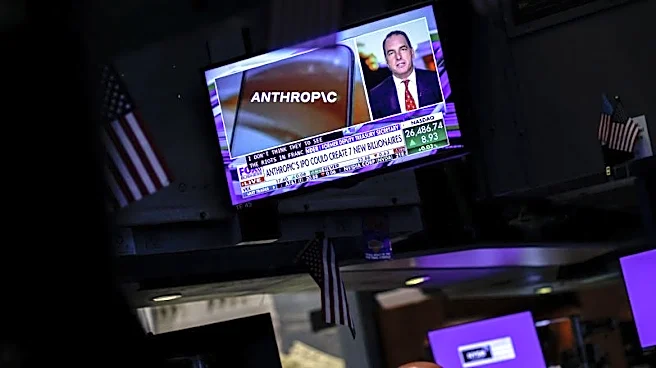
Aswath Damodaran, a finance professor at NYU Stern, has voiced apprehension regarding the IPO price of the artificial intelligence company Anthropic. Damodaran, a respected valuation expert, calculated Anthropic's share value at $77, which is slightly
below its $83 IPO price. He stated that the proximity of his valuation to the IPO price 'terrifies' him, preferring a more significant discount. His valuation model projects Anthropic could eventually achieve $1 trillion in annual revenue, driven by premium pricing, enterprise adoption, and integrated AI agents. However, this ambitious forecast relies on the company consistently doubling its revenue in the coming years, a trajectory that could be challenged by market competition, pricing pressures, and computational resource limitations. Anthropic's shares experienced a nearly 9% decline in regular trading on Friday, with an additional 1% drop in after-hours trading.
Why It's Important?
Damodaran's concerns highlight potential risks for investors in the rapidly expanding AI sector, particularly regarding the valuation of high-growth technology companies. His analysis suggests that while Anthropic possesses significant long-term potential, its current IPO price might not offer a sufficient margin of safety for investors. The professor also pointed out that Anthropic's substantial infrastructure commitments, estimated at nearly $500 billion in compute leases, could become a considerable liability if revenue growth does not keep pace. This situation could strain the company's financial health, especially for a young company not yet generating profits. Furthermore, Damodaran raised governance concerns about Anthropic's founder share structure, which centralizes voting control and could potentially attract regulatory scrutiny, describing it as a 'golden share with even more power' than traditional government golden shares.
What's Next?
Anthropic will need to demonstrate robust revenue growth to justify its current valuation and substantial infrastructure investments. The company's ability to scale its AI offerings, secure enterprise clients, and navigate competitive pressures will be crucial in the coming years. Investors will closely monitor Anthropic's financial performance and its progress toward the ambitious revenue targets outlined in Damodaran's valuation model. The company's unique governance structure, particularly the founder share, may also draw increased attention from regulators and corporate governance advocates, potentially leading to discussions about shareholder rights and control within rapidly growing tech firms. The market's reaction to Anthropic's stock performance in the short term will likely influence broader investor sentiment towards AI IPOs.
Beyond the Headlines
The debate surrounding Anthropic's valuation and governance structure reflects broader challenges in assessing the true worth of cutting-edge AI companies. The rapid pace of technological advancement and the speculative nature of future revenue streams make traditional valuation methods complex. Damodaran's 'terrified' reaction to the IPO price being so close to his own valuation underscores the inherent uncertainty and risk in investing in companies with extremely high growth expectations. The discussion also brings to light the evolving landscape of corporate governance in the tech industry, where founders often retain significant control, raising questions about accountability and long-term shareholder value. This scenario could set a precedent for how future AI companies are valued and structured, influencing investor confidence and regulatory oversight in the burgeoning artificial intelligence market.