








What's Happening?
The global semiconductor market is experiencing significant shifts, with China aggressively investing in its domestic chip production. This push is largely a response to U.S. restrictions on advanced microchips, aiming to reduce China's reliance on foreign
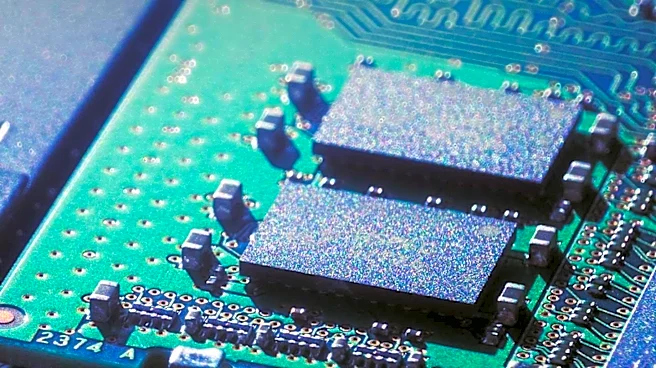
technology. While Taiwan Semiconductor Manufacturing Company (TSMC) currently dominates the production of advanced chips (below 7 nanometers), China is projected to lead in mature-node manufacturing (like 28 nanometers) by 2030, controlling over 30% of global capacity. This development is seen as a potential erosion of Taiwan's 'silicon shield,' a strategic deterrent based on its indispensable role in the global supply chain for cutting-edge semiconductors. The investment in domestic production and R&D by China is intended to achieve chip self-reliance and capability parity, particularly in mature-node chips that power a significant portion of the global economy, including cars and appliances. This strategic move by China highlights a broader trend where countries are investing heavily to gain independence in semiconductor production, leading to a more fragmented and potentially less resilient global supply chain.
Why It's Important?
The shift in semiconductor manufacturing dominance has profound implications for global economics and national security. Taiwan's 'silicon shield,' which has historically provided it with strategic leverage due to its control over advanced chip production, is at risk. If China achieves self-sufficiency in mature-node chips, Taiwan's strategic importance to China could diminish, potentially altering geopolitical dynamics in the region. For the U.S. and its allies, this means a more complex and potentially less secure supply chain for essential technologies. The current global semiconductor supply chain is highly concentrated, with critical chokepoints such as ASML's EUV machines and TSMC's fabrication capabilities. This concentration makes the system vulnerable to disruptions, whether from natural disasters, geopolitical events, or military conflicts. A full-scale conflict over Taiwan, for instance, could lead to an estimated $10.6 trillion loss in global GDP in the first year, surpassing the impact of the 2008 financial crisis. The race for microchip independence, while seemingly aimed at resilience, is inadvertently creating a fragile trade environment with increased costs and potential instability.
What's Next?
In the short term, the U.S. and its allies are likely to continue investing heavily in domestic semiconductor production through initiatives like the CHIPS Act. However, these efforts may lead to more expensive, rather than more resilient, supply chains due to increased steps and costs. China will likely continue its aggressive investment in R&D and manufacturing capacity for mature-node chips, aiming to close the knowledge gap and increase patent applications to achieve capability parity. This will intensify the competition for technological leadership, with Washington seeking to maintain its innovation lead and Beijing striving to end its dependence. The focus will shift from solely advanced chips to who controls the critical chokepoints in the entire semiconductor ecosystem. The long-term outcome could be a bifurcated market: one for cutting-edge, expensive chips produced by a consortium of Western and allied nations, and another for 'good enough' mature-node chips produced by China. This scenario would likely lead to higher prices for consumers globally and continued geopolitical tensions surrounding semiconductor technology.
Beyond the Headlines
The evolving landscape of semiconductor manufacturing extends beyond economic and political competition, touching upon fundamental questions of interdependence versus self-reliance. The historical model of globalized trade, where risk was spread across multiple interchangeable suppliers, is being replaced by a system increasingly reliant on single nodes, creating significant vulnerabilities. This shift challenges the notion that supplier contracts are as good as owning manufacturing capacity, as Western countries previously divested from manufacturing due to high capital intensity and low profitability. China, conversely, viewed manufacturing as strategic infrastructure, a long-term investment for leverage and insurance against trade restrictions. The 'silicon shield' concept, while offering a sense of security for Taiwan, highlights a paradox: dependence can be a deterrent only as long as all parties need the dependent entity. If China can meet its own demand for essential chips, the shield's protective power diminishes, potentially exposing Taiwan to greater risks. This situation underscores the ethical and strategic dilemmas of relying on concentrated supply chains for critical technologies, forcing a re-evaluation of global trade policies and national security strategies.