

What's Happening?
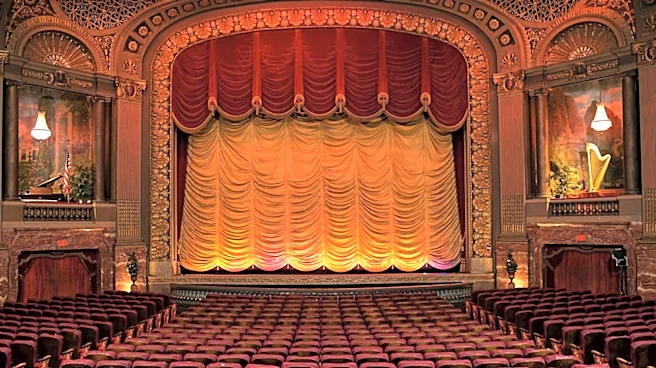
The Royal Academy of Music recently presented an abridged production of Richard Strauss's final opera, 'Capriccio,' set in Paris during World War II. Directed by Olivia Fuchs, the production features a unique staging where the action unfolds on a theater
stage, with panels reversing to transform the setting into a hall of mirrors. The central character, Countess Madeleine, portrayed by Madeleine Perring, is depicted as an operatic muse who interrogates her own reflection to determine the opera's ending. Christopher White, Head of Royal Academy Opera and conductor, led the Royal Academy Sinfonia, highlighting Strauss's mastery of orchestral color and vocal composition. The cast includes Harrison Robb as the Count, Joel Robson as Olivier, Woogyeom Kim as Flamand, Seho Oh as La Roche, Viktoria Melkonian as Clairon, Ellie Donald as Die Sängerin, David Karapetian as Der Tenor, and Pavel Basov as Haushofmeister. The production, though abridged, runs for just over two hours with an interval.
Why It's Important?
This production of 'Capriccio' is significant for its intricate and subtle storytelling, offering a fresh perspective on an opera about opera. The decision to set the piece in World War II Paris, subtly indicated by elements like a yellow star and requisitioned crates, adds a layer of historical context without overshadowing the aesthetic themes. The innovative staging, transforming the set into a hall of mirrors, enhances the opera's self-reflective nature and the Countess's journey of self-discovery. The Royal Academy of Music's commitment to presenting challenging works with high artistic standards contributes to the ongoing vitality of classical music and opera. The performance showcases emerging talent from the Royal Academy, providing valuable experience for young artists and ensuring the continuation of operatic traditions.
What's Next?
While this specific production has concluded, the Royal Academy of Music will likely continue to stage a diverse range of operatic works, providing a platform for both established and emerging artists. The success of this 'Capriccio' production may influence future directorial choices in presenting classic operas with contemporary relevance. Audiences can anticipate further innovative interpretations of traditional works, as well as new productions that push the boundaries of operatic performance. The Royal Academy's ongoing commitment to musical excellence and artistic innovation suggests a future filled with compelling and thought-provoking operatic experiences.
Beyond the Headlines
The production's subtle integration of historical context, such as the World War II setting and references to figures like Max Reinhardt and Stefan Zweig, invites deeper reflection on the relationship between art and historical events. 'Capriccio' itself, as an opera about opera, prompts questions about the nature of artistic creation, the interplay between words and music, and the role of art as a 'magic mirror' for life. The choice to present the action as a flashback and on a theater stage blurs the lines between reality and performance, encouraging the audience to consider the meta-narrative of the work. This layered approach enriches the audience's engagement, moving beyond a simple narrative to explore philosophical and aesthetic dimensions of opera.