







What's Happening?
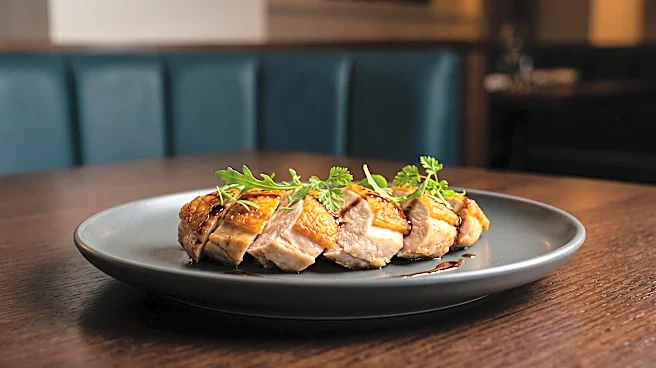
The United States Department of Agriculture (USDA) and the Food and Drug Administration (FDA) have completed regulatory evaluations and granted commercial grants of inspection to two cultivated poultry producers. This approval allows these companies to offer
their products in select culinary venues, marking a significant step for the cultivated meat industry in the U.S. The regulatory framework for these products includes stringent biosecurity protocols, air filtration, continuous sensor monitoring, and rigorous Hazard Analysis Critical Control Point (HACCP) regimes. Additionally, regulatory oversight involves reviewing the metabolic stability of cell lines and assessing the composition of the final food matrix, establishing cultivated meat as a distinct and closely regulated category of novel foods. This development follows Singapore's earlier regulatory approval for cultivated chicken products in December 2020.
Why It's Important?
This regulatory approval by the FDA and USDA is crucial for the nascent cultivated meat industry in the U.S. It provides a pathway for commercialization, moving these products from research and development into the consumer market, albeit initially in a limited capacity. The strict regulatory oversight, encompassing biosecurity and HACCP, aims to ensure food safety and consumer confidence in these novel products. This move could also reduce the reliance on traditional animal agriculture, potentially addressing concerns about antimicrobial resistance, as cultivated meat production is designed to minimize the need for routine antibiotics. Furthermore, it positions the U.S. as a key player in the global cultivated meat market, following Singapore's lead in regulatory milestones. The ability to produce meat without traditional animal farming could have long-term implications for food security and environmental sustainability.
What's Next?
While commercial grants of inspection have been issued, retail distribution of cultivated meat remains limited. The immediate next steps involve the two approved producers beginning limited service in select culinary venues. The industry will focus on scaling production to achieve economic parity with conventional meat, which currently presents a significant bioprocess engineering challenge. This includes reducing input costs, improving cell proliferation density, and optimizing energy efficiency. Regulatory agencies will likely continue to refine oversight as the industry evolves, particularly concerning the metabolic stability of cell lines and the composition of the final food matrix. Consumer acceptance will also be a critical factor, influenced by ongoing education and the industry's ability to address concerns about the 'lab-grown' perception. Future developments may also include the expansion of approvals to other types of cultivated meat and broader distribution channels.
Beyond the Headlines
The emergence of cultivated meat raises profound ethical, cultural, and economic questions beyond its immediate market entry. Ethically, it challenges traditional notions of meat production and consumption, offering an alternative that avoids animal slaughter. Culturally, it introduces a new category of food that may face skepticism or embrace, depending on consumer perceptions and marketing efforts. The distinction between cultivated meat and plant-based alternatives is critical, as cultivated meat is genuine animal tissue grown from animal cells, not a plant-based analog. This distinction will influence dietary and religious considerations, prompting theological scholars and certification authorities to determine its permissibility. Economically, while currently expensive, successful scaling could disrupt traditional agriculture, impacting livestock farmers and related industries. The long-term environmental impact will depend heavily on the energy sources used for bioreactors, highlighting the need for renewable energy integration to maximize sustainability benefits.