







What's Happening?
GE Vernova has announced significant advancements in its hydrogen-ready aeroderivative gas turbine solutions, validated at its Global Technology Center in Greenville, South Carolina. The company confirmed the LM2500XPRESS aeroderivative gas turbine package
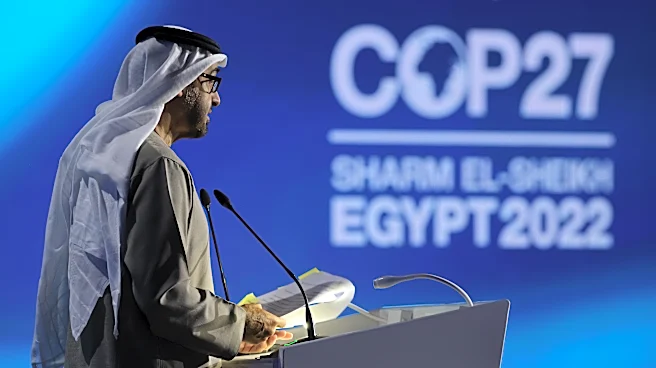
can operate on fuel blends containing up to 50% hydrogen in a Dry Low Emission (DLE) configuration. Additionally, the LM6000VELOX aeroderivative gas turbine package successfully completed testing for 100% hydrogen capability in a Singular Annular Combustion (SAC) configuration. These developments were announced at the COP31 meeting in Antalya, Turkey. GE Vernova's global gas turbine fleet has accumulated over 11 million operating hours on hydrogen and hydrogen-blended fuels, with more than 120 gas turbines already operating on such fuels. The company emphasizes its leadership in gas turbine fuel flexibility, providing proven operational reliability in real-world conditions. These hydrogen-capable gas turbines are designed to support various industrial applications, including steel, refining, and petrochemicals, offering fast-starting and flexible power generation crucial for grid stabilization and meeting peak demand.
Why It's Important?
These advancements are crucial for the U.S. energy transition, offering a pathway to reduce carbon emissions in power generation and industrial sectors. By enabling gas turbines to operate on hydrogen, GE Vernova provides a solution for industries to lower their carbon footprint while maintaining reliable power supply. This technology is particularly significant for stabilizing electric grids, managing peak demand, and responding to fluctuating system conditions, which are increasingly important with the integration of intermittent renewable energy sources. The ability to use hydrogen as a fuel allows for a more sustainable energy infrastructure, bridging current fuel usage with future lower-carbon options. This innovation benefits industrial and municipal operators, including data centers and utilities, by ensuring a steady and flexible power supply. The rigorous testing under real-world conditions underscores the reliability and practicality of these solutions, positioning GE Vernova as a key player in decarbonizing the energy sector.
What's Next?
GE Vernova plans to continue expanding its hydrogen combustion technology across its gas turbine portfolio, including heavy-duty gas turbines. The company's current HA-class gas turbines, such as the 7HA and 9HA platforms, are already capable of burning up to 50% hydrogen by volume when blended with natural gas. Future efforts will likely focus on increasing hydrogen blending capabilities and achieving 100% hydrogen operation across more models. The dedicated aeroderivative testing facility in Greenville, South Carolina, will play a critical role in accelerating product testing and reducing development lead times for hydrogen-ready power solutions. This will enable GE Vernova to provide enhanced support to customers globally as they transition to lower-carbon energy sources. Further deployments and tests at various facilities, such as those in DeBary (USA) and NYPA Brentwood (USA), are expected to continue, demonstrating the practical application and scalability of these technologies.
Beyond the Headlines
The broader implications of GE Vernova's hydrogen advancements extend to significant shifts in energy policy and infrastructure development. The increased viability of hydrogen as a fuel source could accelerate investments in hydrogen production, storage, and distribution infrastructure across the U.S. This development supports national decarbonization goals and could foster new economic opportunities in the green hydrogen sector. Ethically, it addresses the imperative to reduce greenhouse gas emissions without compromising energy reliability, offering a pragmatic solution for industries heavily reliant on gas turbines. Legally, it may influence regulatory frameworks to incentivize hydrogen adoption and infrastructure build-out. Culturally, it signifies a move towards a more sustainable energy paradigm, potentially shifting public perception and acceptance of hydrogen as a mainstream energy carrier. This technological leap could also spur further innovation in related fields, such as carbon capture and storage, as industries seek comprehensive solutions for emissions reduction.