



What's Happening?
Satlyt, a startup with joint headquarters in Nairobi, Kenya, and Sunnyvale, CA, has announced an $8 million seed funding round. This investment aims to expand its team and its virtual orbital data center (ODC) network. Unlike traditional ODC concepts
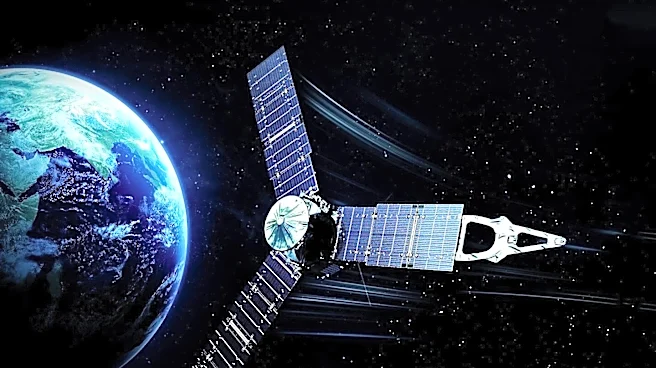
that require new engineering feats, Satlyt's approach involves injecting AI-inference capabilities onto existing partner satellites, either pre-launch or in-flight. This allows for in-orbit data processing, reducing the amount of data that needs to be downlinked. The funding round was led by non sibi ventures, with additional participation from several other firms including TLCOM, Antler, and Slauson & Co. This brings Satlyt's total funding to over $10 million. Founded in 2024 by Rama Afullo, an alum of SpaceX and Google, Satlyt recently won a NASA STTR contract valued at $4 million to design delay-tolerant edge protocols in space and successfully demonstrated its ability to run Google's Gemma AI model in orbit.
Why It's Important?
Satlyt's successful funding and technological advancements signify a pivotal shift in the space industry towards more efficient and intelligent data processing in orbit. By processing data on satellites before downlinking, the company addresses a critical challenge of managing the vast amounts of data collected by satellites, which is often too extensive and costly to transmit efficiently. This innovation has significant implications for various U.S. industries that rely on satellite data, including defense, agriculture, environmental monitoring, and telecommunications, by providing faster and more cost-effective access to processed information. The ability to run AI inference in space could lead to quicker insights and decision-making for both government agencies and private enterprises. Furthermore, Satlyt's strategy of integrating with existing satellite infrastructure, rather than building new hardware-intensive ODCs, offers a more scalable and potentially faster path to widespread adoption of in-space edge computing, benefiting a broader range of satellite operators and data users.
What's Next?
With the new capital, Satlyt plans to hire new engineers and invest in research and development to accelerate its product development. The company's long-term vision is to integrate its software across a significant portion of non-SpaceX Starlink satellites, aiming to onboard 30% of all such satellites by the end of the decade. This expansion will involve growing its network and enhancing its in-orbit capabilities. Satlyt views its system as complementary to hardware-focused ODC concepts, aiming to provide them with a larger customer base and reduce downtime. The recent Memorandum of Understanding with xOrbita and ODC startup Symphony Space to explore joint software-defined in-space architecture indicates a collaborative approach to developing the future of orbital data processing. This suggests a future where in-space computing becomes more ubiquitous and integrated across various satellite platforms, potentially leading to a more robust and efficient space data ecosystem.
Beyond the Headlines
Satlyt's model of virtual ODCs highlights a broader trend in the technology sector: the increasing importance of software-defined solutions over purely hardware-centric approaches. This shift could democratize access to advanced in-space computing capabilities, making them available to a wider array of satellite operators, including smaller entities and developing nations. The ethical implications of processing sensitive data in orbit, particularly with AI, will become increasingly relevant, necessitating robust security protocols and regulatory frameworks. Furthermore, the ability to process data at the edge in space could reduce the digital divide by enabling more localized and efficient data services for remote areas. This development also points to a future where satellites are not just data collectors but intelligent processing hubs, fundamentally changing how we interact with and utilize space-derived information, potentially fostering new applications and industries that are currently unimaginable.