



What's Happening?
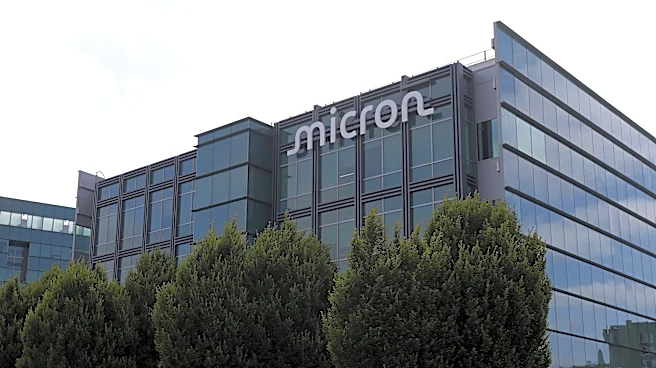
Micron Technology, a U.S.-owned memory-chip maker with significant operations in Taiwan, is facing a potential strike by its Taiwanese employees. Unions representing workers at Micron's Taoyuan and Taichung sites have rapidly grown, now encompassing over
10,000 members, approximately two-thirds of the 15,000 employees across both locations. This development comes despite Micron's revenue soaring 3.5-fold and its share price increasing by 488% this year. Workers have been offered only a one-off bonus, leading to widespread dissatisfaction. An internal online survey in August revealed that over 80% of participating union members support strike action. In response, Micron's management announced 'thank-you' bonuses of NT$1 million for staff hired before August 29 of the previous year. However, unions have rejected this as a tactic to weaken their resolve, demanding that 15% of operating profit be distributed quarterly as a regular arrangement, similar to models established at Samsung and SK Hynix.
Why It's Important?
This brewing strike at Micron Technology highlights growing labor unrest within the critical semiconductor industry, a sector vital to the U.S. economy and global technology supply chains. A disruption at Micron, a key player in memory chip production, could impact the availability and cost of components essential for various electronic devices and AI infrastructure. The workers' demands for profit-sharing reflect a broader trend of employees seeking a larger share of the unprecedented profits generated by the AI boom, particularly in industries where wages have not kept pace with company growth and inflation. The outcome of this dispute could set a precedent for labor relations in the high-tech manufacturing sector, potentially influencing other U.S. and international companies operating in Taiwan and beyond. It also underscores the challenges companies face in balancing shareholder returns with employee compensation in a rapidly evolving economic landscape.
What's Next?
The unions at Micron's Taoyuan and Taichung sites are insisting on their demand for 15% of operating profit to be distributed quarterly, rejecting the one-off bonus offered by management. The situation suggests that strike action remains a strong possibility if a satisfactory agreement is not reached. The development of this struggle will be closely watched, particularly given the precedent set by labor movements in South Korea, such as the Samsung strike. The actions of Micron's management in the coming weeks will be crucial in determining whether a strike can be averted or if the dispute escalates. The broader implications for other companies in the electronics industry, both in Taiwan and globally, are significant, as successful union actions could inspire similar movements elsewhere.
Beyond the Headlines
The situation at Micron Technology reflects a deeper tension within the global capitalist system, particularly in high-growth sectors like AI and semiconductors. While companies experience exponential growth and record profits, a significant portion of the workforce feels left behind, struggling with stagnant wages and rising personal debt. This disparity is fueling a resurgence of labor activism, transforming workers from a 'class in itself' to a 'class for itself,' as described by Marxist theory. The demand for profit-sharing, rather than just one-off bonuses, indicates a shift towards workers seeking systemic changes in how corporate wealth is distributed. This movement could lead to a re-evaluation of labor practices and corporate social responsibility in the tech industry, potentially influencing policy discussions around wealth inequality and worker rights in the U.S. and internationally.