





What's Happening?
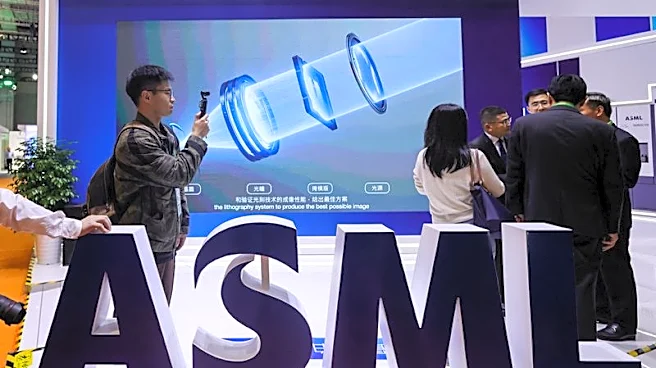
ASML, a key manufacturer of advanced chipmaking tools, is experiencing increased pressure from the U.S. regarding its ability to ship these tools to China. This development highlights how U.S. policy is influencing the global semiconductor supply chain
and adding constraints to an already cyclical market. ASML's lithography machines are crucial for producing sophisticated chips, particularly those used in AI. The company finds itself caught between Washington's security concerns and Europe's industrial interests. U.S. lawmakers are advocating for stricter export rules, partly in response to controversies surrounding potential covert sales of advanced chips to China by other companies like Nvidia. This regulatory environment is reducing ASML's commercial flexibility in China, which is one of its largest overseas markets, even as demand remains strong in other regions. The market has reacted, with ASML's shares falling significantly from their 2026 highs, indicating investor concern that policy, rather than just the semiconductor cycle, could limit the company's near-term growth.
Why It's Important?
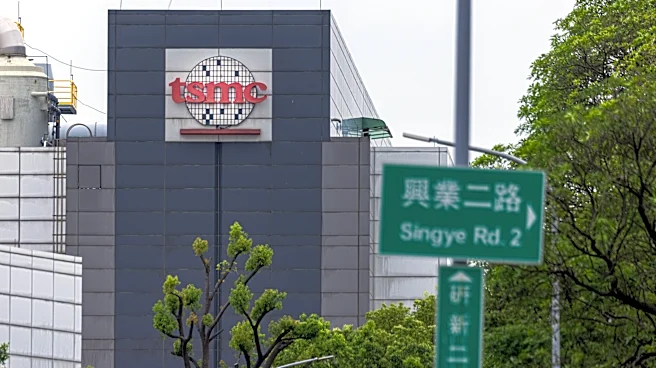
This renewed U.S. export pressure on ASML is significant because it directly impacts the global semiconductor industry, a foundational element for modern technology and AI development. By restricting the flow of advanced chipmaking tools to China, the U.S. aims to curb China's technological advancement, particularly in areas deemed critical for national security. For ASML, this means a potential shift in its sales mix, margins, and order timing, making its financial performance more susceptible to U.S.-China technology policy. The situation also creates a ripple effect across the semiconductor ecosystem, affecting companies like Nvidia and Taiwan Semiconductor Manufacturing Co., which are also exposed to U.S. export controls and global AI-related capital expenditure. The tightening restrictions could force China to accelerate its efforts in local semiconductor substitution, while ASML's rivals outside China might face less policy risk, potentially altering market dynamics and competition.
What's Next?
The immediate future hinges on whether U.S. policymakers will formalize and expand current restrictions on advanced chipmaking tool exports to China. If new regulations, such as a proposed Match Act, are enacted, ASML's commercial flexibility in China will further diminish. This could lead to a more pronounced dependence on a limited number of large customers outside China, making ASML's stock more sensitive to shifts in U.S.-China technology policy. Investors will be closely watching to see if the China clampdown becomes a long-term structural earnings headwind or if ASML can manage the reallocation of demand effectively, leveraging its backlog, monopoly in extreme ultraviolet lithography, and strong AI spending in other regions. The broader semiconductor complex will also continue to experience volatility as companies navigate these evolving restrictions and demand expectations.
Beyond the Headlines
The ongoing U.S. pressure on ASML to restrict sales to China highlights a deeper geopolitical struggle for technological supremacy. This isn't merely an economic issue but a strategic one, with implications for national security, global power dynamics, and the future of AI development. The ethical dimension arises from the tension between free trade principles and national security concerns, forcing companies like ASML to navigate complex political landscapes. Legally, the expansion of export controls could set precedents for how governments regulate critical technologies across borders. Culturally, it could foster a more fragmented global technology ecosystem, potentially leading to divergent technological standards and innovation pathways between different geopolitical blocs. In the long term, this could accelerate China's drive for technological self-sufficiency, potentially creating a more bifurcated global semiconductor market and reshaping international technological cooperation.