
What's Happening?
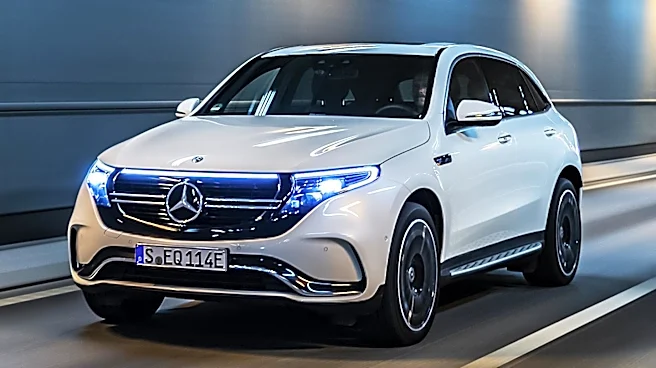
Mercedes-Benz reported a 6% increase in U.S. car sales during the third quarter, reaching 75,300 units. This growth contributes to a 12% rise in U.S. sales for the first nine months of the year. North
American sales also saw a 4% increase, totaling 83,200 units. A significant factor in this performance was the record-breaking sales of battery-electric vehicles (BEVs), which accounted for 16.8% of all car sales, marking a 7.2 percentage point increase from the previous year. Including plug-in hybrids, electrified vehicles constituted 25% of total car sales. Globally, group BEV sales across cars and vans surged by 52% to 78,100 units. The electric GLC, CLA, GLB, and GLA models are reportedly sold out in Europe until the end of 2026, with order books extending into 2027, leading to three-shift schedules at manufacturing plants in Bremen, Rastatt, and Kecskemét. While U.S. sales showed strength, overall Mercedes-Benz car sales globally declined by 8% to 407,200 units in Q3, primarily due to challenging market conditions in China, where sales fell by 31%.
Why It's Important?
The robust growth in Mercedes-Benz's U.S. sales, particularly in the electric vehicle segment, underscores a significant shift in consumer preferences and market dynamics within the American automotive industry. This trend indicates increasing adoption of electric vehicles in the U.S., which could accelerate the transition away from internal combustion engines and impact related sectors such as charging infrastructure, battery manufacturing, and energy supply. The strong demand for Mercedes-Benz BEVs in the U.S. and Europe, leading to sold-out models and increased production shifts, suggests a positive outlook for luxury electric vehicle manufacturers. This could encourage further investment in EV research and development, potentially fostering innovation and competition. Conversely, the decline in global sales, largely attributed to the Chinese market, highlights the varying regional challenges and opportunities for international automakers. For the U.S. market, this performance could signal a growing appetite for premium electric vehicles, influencing other manufacturers to prioritize their EV offerings and potentially reshaping the competitive landscape.
What's Next?
Given the strong demand for electric vehicles, Mercedes-Benz is likely to continue prioritizing the expansion of its BEV lineup and production capacity, particularly for models popular in the U.S. and European markets. The company's focus on electrified vehicles, including plug-in hybrids, suggests a sustained strategy to meet evolving consumer preferences and regulatory requirements. The introduction of new models like the electric CLA in the U.S. and Japan, alongside the arrival of the new GLE, GLE Coupé, and GLS at U.S. dealerships, indicates a continuous effort to refresh and diversify their offerings. Future reports will likely detail the impact of these new models on sales figures and market share. The ongoing challenges in the Chinese market will also be a critical area to watch, as Mercedes-Benz may need to adapt its strategies to address intense competition and market conditions in that region. The continued monitoring of BEV sales percentages will be crucial in understanding the pace of electric vehicle adoption and its broader implications for the automotive industry.
Beyond the Headlines
The surge in U.S. electric vehicle sales for Mercedes-Benz reflects a broader societal shift towards sustainable transportation and a growing environmental consciousness among consumers. This trend has implications beyond just sales figures, influencing urban planning, energy policy, and infrastructure development. The increasing demand for luxury electric vehicles could also drive innovation in battery technology, charging solutions, and autonomous driving features, as manufacturers compete to offer advanced and appealing products. Furthermore, the disparity between strong U.S. and European sales and the decline in China highlights the complex geopolitical and economic factors at play in the global automotive market. This could lead to a re-evaluation of global manufacturing and distribution strategies, with a potential emphasis on regional production to mitigate supply chain risks and cater to specific market demands. The success of electric vehicles in the premium segment may also pave the way for broader adoption across different price points, accelerating the overall transition to an electric future.