









What's Happening?
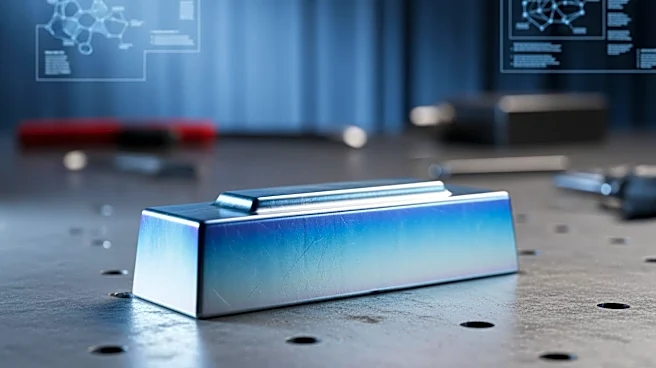
Researchers at Purdue University have made significant advancements in the development of cobalt aluminum (CoAl) intermetallics, achieving a combination of high strength and plasticity. This breakthrough was detailed in a paper published in Science Advances,
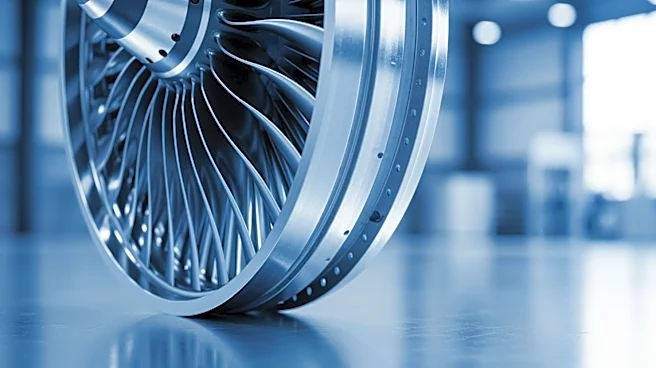
where the team demonstrated that CoAl intermetallics could sustain a yield strength of 6 GPa and a compressive plastic strain of 15% at room temperature. The research, led by Xinghang Zhang and involving collaborators such as Haiyan Wang and Ke Xu, utilized a nonequilibrium fabrication approach known as magnetron sputtering deposition. This method allowed the introduction of high-density dislocations and the creation of a framework of amorphous interfaces, which are crucial for enhancing the material's plasticity. The study's findings suggest that these intermetallics could be used in demanding applications like turbine blades for aeroengines, potentially improving performance by allowing engines to operate at higher speeds and forces.
Why It's Important?
The development of high-strength, plastically deformable CoAl intermetallics represents a significant advancement in materials engineering, with potential applications in aerospace, energy, and defense industries. These materials could lead to the creation of more efficient and durable components for jet engines and gas turbines, which are critical for modern transportation and energy systems. The ability to process these intermetallics into complex structures at room temperature could also reduce manufacturing costs and increase the feasibility of using such materials in various industrial applications. Furthermore, the research highlights the potential for using similar techniques to enhance other intermetallics, broadening the scope of materials available for high-performance applications.
What's Next?
The next steps for the researchers involve scaling up the production of CoAl nanocomposites for industrial applications and testing the applicability of their approach to other intermetallics. This could establish a new standard for improving plasticity in metals, potentially leading to a wider range of high-performance materials. The research team, led by Zhang's Nanometal Group, will continue to explore the integration of synthesis, in situ nanomechanical testing, and advanced microstructure characterization to design materials with superior mechanical properties. These efforts could pave the way for significant advancements in the design of materials for aerospace, energy, and defense sectors.