



What's Happening?
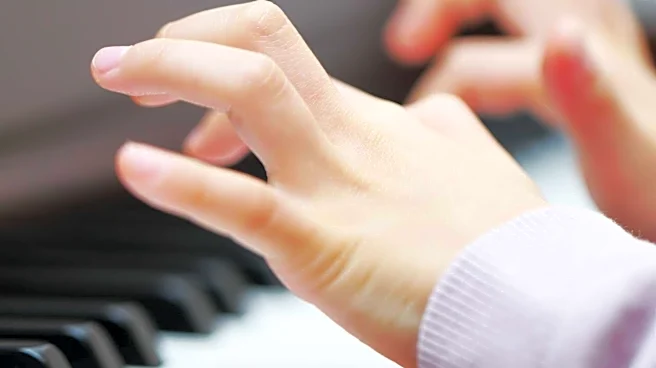
New conceptual analysis published in Frontiers in Psychology investigates body percussion as a form of embodied creativity, focusing on its minimal mechanical mediation compared to other musical practices. The research defines 'mechanical mediation' as the transfer
function artifacts introduce between a performer's effector contact and the acoustic onset, characterized by latency, jitter, and velocity dependence. Body percussion, where the body itself is the instrument, is identified as the baseline with minimal mechanical mediation. The study proposes that in body percussion, the agent, instrument, and material converge in a 'Body-Self,' a process of individualization shaped by lived experience, cultural signs, and interaction with others. This framework suggests that creativity in body percussion is distributed across these Body-Selves, cultural artifacts like metrical cycles, and irreversible time. The analysis also introduces seven testable hypotheses to further explore these claims, including how the unsystematic part of an incorporated transfer function causally affects timing and how mechanical mediation shapes distributed creativity.
Why It's Important?
This research offers a novel theoretical framework for understanding creativity, particularly in the context of music and embodied practices. By highlighting body percussion's minimal mechanical mediation, it provides a unique lens to study the fundamental aspects of human-instrument interaction and the role of the body in creative expression. The concept of the 'Body-Self' and distributed creativity could influence pedagogical approaches in music education, encouraging methods that emphasize sonic-motor problems, body memory, and collaborative learning. For fields like cognitive science and psychology, the testable hypotheses provide avenues for empirical research into sensorimotor synchronization, improvisation, and the interplay between individual and collective creative processes. Understanding these dynamics can shed light on how humans learn, adapt, and create within complex, interactive systems, potentially impacting areas beyond music, such as rehabilitation and human-computer interaction.
What's Next?
The study outlines seven specific hypotheses that require empirical testing. Future research will involve experiments manipulating latency and jitter in hand-struck digital pads to observe their effects on timing and variability, comparing these results with body percussion. Studies will also investigate paired improvisation in body percussion versus instruments with higher mechanical mediation, and the impact of visual access on creative contingency. Further work will explore how rhythmic-motor metaphors taught through movement influence improvisation compared to verbal instruction. Additionally, researchers plan to examine how timing and variation profiles change with ensemble position in performers, linking these shifts to individual learning histories and instrumental training. The framework also suggests comparative work across diverse body percussion traditions globally to test the universality of its claims, and an extension to include dance as a comparative term.
Beyond the Headlines
The conceptualization of the 'Body-Self' in this research delves into the philosophical dimensions of human experience, suggesting that the body is not merely a vessel but an active participant in shaping perception, action, and creativity. This perspective challenges traditional views that separate mind and body, emphasizing their integrated role in cognitive processes. The study's focus on 'minimal mechanical mediation' in body percussion implicitly raises questions about the increasing mediation in modern life through technology and its potential impact on human creativity and embodied experience. It suggests that a return to more direct, unmediated forms of interaction could foster different kinds of creative engagement. Furthermore, the emphasis on distributed creativity within an ensemble highlights the social and relational aspects of artistic production, moving beyond the individualistic genius narrative and underscoring the importance of collective dynamics in innovation.