







What's Happening?
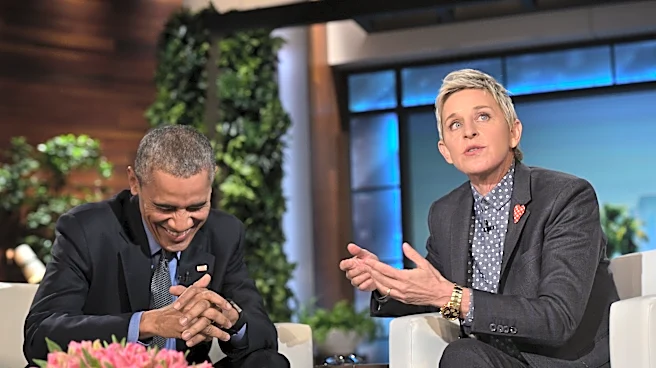
Ellen DeGeneres is facing significant criticism online after reportedly donating $5,000 to a GoFundMe campaign for her late executive producer, Matthew Wright. Wright, who worked with DeGeneres for 16 years, passed away suddenly at the age of 52. DeGeneres shared
an emotional tribute to Wright on social media, calling him 'the glue to our entire family' at 'The Ellen Show' and highlighting his kindness and humor. However, the reported donation amount has drawn backlash from social media users who point to DeGeneres' estimated net worth of $450 million, suggesting the contribution was insufficient given her wealth and Wright's long tenure with her. The GoFundMe campaign, initiated by Wright's family, aims to cover costs for transporting his remains to New York, funeral services, and a Los Angeles memorial, and has surpassed its original $50,000 goal, raising over $94,000.
Why It's Important?
This incident highlights the public's scrutiny of celebrity philanthropy and the perceived disconnect between immense wealth and charitable contributions, especially in personal contexts. For public figures like Ellen DeGeneres, actions, even those intended as private gestures of support, are often viewed through the lens of their public image and financial standing. The criticism reflects a broader societal expectation that individuals of significant means should contribute proportionally to causes, particularly when those causes involve former colleagues or close associates. This event could further impact DeGeneres' public perception, which has previously faced challenges regarding workplace culture allegations. It also underscores the power of social media in shaping narratives and influencing public opinion on celebrity actions.
What's Next?
The immediate aftermath will likely see continued discussion on social media regarding DeGeneres' donation and the broader implications of celebrity giving. While the GoFundMe campaign for Matthew Wright's family has already exceeded its goal, the controversy surrounding DeGeneres' contribution may persist. This situation could prompt other public figures to be more transparent or strategic in their charitable efforts to avoid similar public relations challenges. For DeGeneres, managing this public reaction will be crucial, especially as she attempts to re-establish her career with new projects following the conclusion of her talk show. The incident may also lead to increased public discourse on wealth inequality and the responsibilities of the ultra-rich.
Beyond the Headlines
Beyond the immediate financial aspect, this controversy touches upon deeper ethical and cultural dimensions concerning the nature of professional relationships and the expectations placed on employers, particularly in the entertainment industry. Wright was described as a long-time collaborator and friend, and the public reaction suggests an expectation of a more substantial gesture from someone of DeGeneres' stature towards a dedicated employee. This incident could contribute to a broader conversation about how companies and high-profile individuals support their staff, especially in times of personal tragedy, and the perceived moral obligations that extend beyond contractual employment. It also reflects a growing public demand for accountability and authenticity from celebrities, where private actions are increasingly scrutinized for their alignment with public personas.