



What's Happening?
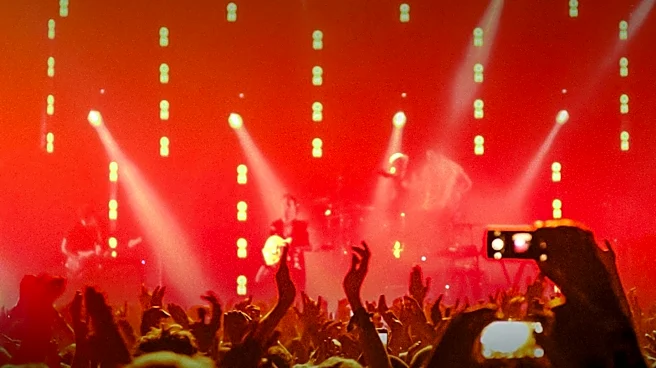
Boy George recently performed at the Menora Mivtachim Arena in Tel Aviv, delivering a concert that blended Culture Club hits with lengthy speeches and personal anecdotes. The show, which lasted over two hours, featured collaborations, including a duet
with Israeli singer Ivri Lider on 'Do You Really Want to Hurt Me.' Despite some audience members noting the inclusion of less familiar songs and extended monologues between numbers, George engaged with the crowd, sharing his perspectives and even learning a fan's name. A significant moment of the evening was his performance of 'We Will Dance Again,' a song dedicated to the victims of the Nova festival massacre, during which he expressed solidarity with the Israeli audience. His appearance in Israel comes at a time when many international artists have refrained from performing in the region.
Why It's Important?
Boy George's decision to perform in Tel Aviv holds considerable significance given the current geopolitical climate, where many international artists have opted out of engagements in Israel. His presence and explicit expressions of support, such as singing 'I stand with the Jews,' can be seen as a powerful statement of solidarity. This act potentially influences public perception and encourages other artists to consider performing in the region, challenging the prevailing trend of boycotts or cancellations. For the Israeli audience, the concert provided not only entertainment but also a sense of connection and validation from an international figure, particularly during a period of heightened tension. His willingness to engage with the local context, including visiting a memorial site, further amplifies the impact of his visit beyond a typical musical performance.
What's Next?
The reception of Boy George's concert in Tel Aviv may influence future decisions by other international artists regarding performances in Israel. His public stance and the positive audience response could potentially encourage a re-evaluation of touring schedules by artists who have previously hesitated. While no immediate follow-up concerts or specific political actions are directly indicated, the event could spark broader discussions within the entertainment industry about engaging with regions experiencing conflict. The impact of his performance, particularly the emotional resonance of 'We Will Dance Again,' may also foster continued dialogue about the role of music and artists in times of crisis and their capacity to offer comfort and solidarity.
Beyond the Headlines
Boy George's concert in Tel Aviv transcends a typical musical event, touching upon deeper themes of cultural diplomacy, artistic courage, and the power of music to bridge divides. His willingness to perform and express solidarity in a contentious region highlights the ethical considerations artists face when navigating global conflicts. By openly acknowledging the difficulties he faced in his own career and connecting that to the Israeli audience's sense of being 'outsiders,' he tapped into a shared human experience of resilience and perseverance. This performance could be viewed as a subtle yet potent form of cultural exchange, demonstrating how art can serve as a platform for empathy and understanding, even amidst complex political landscapes, and challenging the notion that artists should remain entirely apolitical.