






What's Happening?
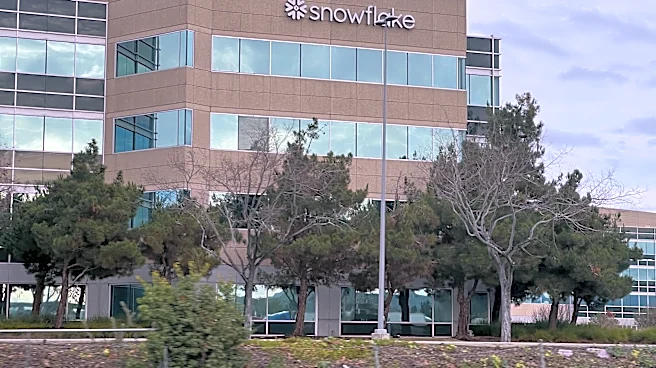
Snowflake, the AI Data Cloud company, announced significant innovations and platform updates at its Snowflake Expedition 2026 event. These advancements are designed to establish Snowflake as the foundation for the 'agentic enterprise,' enabling organizations
to deploy AI agents that comprehend business contexts, adhere to controls, and deliver reliable results. Key introductions include Business Ontology, which grounds AI agents in approved business definitions, and Cortex AI Gateway, which governs every model, tool, and action these agents utilize. Additionally, Snowflake unveiled updates to Snowflake CoCo, a coding agent for data teams, and Snowflake CoWork, a personal work agent for knowledge workers. These new features, including CoCo and CoWork Bots, are designed to automate recurring tasks and operate autonomously in the background across various tools like Slack and Excel, only requiring human intervention for critical decisions. The company also highlighted its partnership with USA Cycling as its Official AI Data Cloud and Collaboration Partner for the LA28 Games, leveraging Snowflake Cortex AI for training and race data analysis.
Why It's Important?
These innovations are crucial for U.S. businesses as they address a significant challenge in AI adoption: trust and control. Many enterprises struggle to move AI agents from pilot phases to production due to concerns about a lack of business context and fragmented data, as highlighted by an MIT Technology Review report sponsored by Snowflake. By providing a governed control plane for AI agents, Snowflake aims to bridge this gap, allowing companies to scale reliable AI systems efficiently while reducing maintenance overhead. The ability to define business terms through Business Ontology and enforce policies via Cortex AI Gateway ensures that AI agents operate within established organizational rules and financial limits. This development is particularly important for industries seeking to leverage AI for enhanced decision-making, operational efficiency, and competitive advantage, as it offers a structured and secure environment for AI deployment. The partnership with USA Cycling also demonstrates the practical application of Snowflake's AI capabilities in high-performance environments.
What's Next?
Snowflake's newly announced features, including Business Ontology and Cortex AI Gateway, are either generally available or in public/private preview, indicating a phased rollout to customers. Organizations can expect to integrate these tools to enhance their AI agent deployments, moving beyond pilot projects to full-scale production. The company will continue to focus on enabling AI agents to understand business context, operate within governance frameworks, and execute tasks autonomously. Future developments will likely involve further refinement of these agentic capabilities and expansion of their application across various enterprise functions. The success of these innovations will depend on their adoption by Snowflake's extensive customer base and their ability to demonstrate tangible improvements in efficiency and decision-making. Snowflake will also release its third-quarter fiscal 2027 financial results, which will provide further insight into the company's performance and the impact of its AI-driven strategies.
Beyond the Headlines
The shift towards 'agentic enterprises' powered by AI, as championed by Snowflake, signifies a broader transformation in how businesses operate. This evolution moves beyond simple automation to intelligent systems that can understand, act, and learn within defined parameters. The ethical and legal implications of autonomous AI agents, particularly concerning data privacy, accountability, and decision-making biases, will become increasingly prominent. Snowflake's emphasis on 'governed control' and 'business context' attempts to address these concerns by embedding guardrails and transparency into AI operations. However, the long-term societal impact of widespread AI agent adoption, including potential changes in workforce dynamics and the nature of human-computer interaction, remains a critical area for observation. The ability of these systems to operate with minimal human oversight could lead to unprecedented efficiencies but also necessitates robust frameworks for oversight and ethical deployment.