

What's Happening?
A U.S.-led consortium has reached an agreement to acquire Lukoil International GmbH (LIG), which encompasses the non-Russian oil and gas assets of Russia's PJSC Lukoil. The consortium is spearheaded by investment firm Eldridge and includes the U.S. International Development
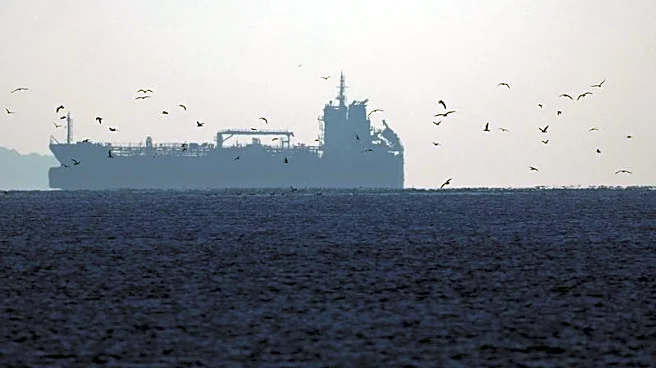
Finance Corporation (DFC), UAE-based Catena Investment Holding, and Xtellus Partners. Citi is serving as the lead financial adviser. This deal involves a share-swap payment method, utilizing restricted Russian shares of PJSC Lukoil and other Russian companies instead of cash. The proceeds from the sale will be held in a restricted custodial account for five years or until sanctions are lifted. The acquisition is contingent upon conditional approval from the U.S. Treasury Department's Office of Foreign Assets Control (OFAC). LIG's portfolio includes upstream operations across 11 countries, three refineries in Bulgaria, the Netherlands, and Romania, the LITASCO trading business, and over 2,000 retail gas stations in 16 countries.
Why It's Important?
This acquisition is significant for U.S. energy security and geopolitical strategy. By bringing Lukoil's international assets under American and allied ownership, the deal aims to stabilize operations and strengthen energy supply chains, particularly in regions like the Balkans. The involvement of the U.S. International Development Finance Corporation (DFC) signifies a direct U.S. government interest in the transaction, with DFC taking an ownership stake at no upfront cost. This move is a direct consequence of U.S. sanctions imposed on Lukoil in late 2025, which prompted a year-long search for a buyer for these assets. The share-swap payment mechanism ensures that no direct cash flows to Russia, aligning with the intent of sanctions. The separation of LIG from PJSC Lukoil at closing will further isolate the Russian entity from its international operations, impacting its global reach and revenue streams.
What's Next?
The immediate next step for the U.S.-led consortium is to secure conditional approval from the U.S. Treasury Department's Office of Foreign Assets Control (OFAC). Following this, the deal will proceed to due diligence and other regulatory approvals. Upon closing, the consortium plans to prioritize stabilizing operations and bringing full refining capacity back online. The sale proceeds will remain in a restricted custodial account for five years or until sanctions against Russia are lifted, indicating a long-term commitment to the current sanctions regime. The full separation of LIG from PJSC Lukoil is also a key component of the closing process. This transaction could set a precedent for how sanctioned Russian assets are managed and transferred in the future, potentially influencing other similar divestment efforts.
Beyond the Headlines
The acquisition of Lukoil's international portfolio by a U.S.-led consortium carries broader implications beyond immediate energy security. It represents a strategic move to diminish Russia's economic influence globally, particularly in the energy sector, by transferring key assets to Western control. The innovative share-swap payment method, which avoids direct cash payments to Russia, highlights the evolving strategies employed to enforce sanctions while facilitating necessary economic transitions. This deal could also reshape regional energy markets, especially in Europe, by introducing new ownership and operational priorities for critical infrastructure like the Burgas refinery in Bulgaria. Furthermore, the DFC's direct ownership stake underscores a growing trend of government-backed involvement in strategic economic acquisitions aimed at countering geopolitical adversaries and enhancing national security interests.