



What's Happening?
Tesla, a leading electric vehicle manufacturer, has reportedly drawn significant inspiration from its Chinese competitor, BYD, particularly in terms of cost-saving strategies. John McNeill, who served as Tesla's president from 2015 to 2018, revealed in a recent
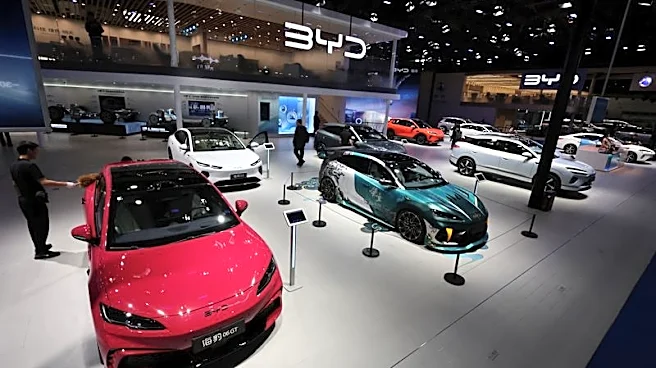
interview that Tesla adopted several practices from BYD during the development of the Model 3 and Model Y. BYD's approach involved reusing parts across different models to save costs, a strategy that Tesla emulated. This method allowed Tesla to use approximately 75% of the same parts in both the Model 3 and Model Y, effectively reducing production costs while maintaining model variety. This revelation comes amidst a backdrop of criticism from Tesla fans who have historically downplayed BYD's vehicles as inferior. However, BYD has grown significantly, now producing more vehicles than Tesla and employing a comparable number of research and development engineers.
Why It's Important?
The acknowledgment of BYD's influence on Tesla underscores the competitive and collaborative dynamics within the electric vehicle industry. By adopting BYD's cost-saving strategies, Tesla has been able to enhance its production efficiency and maintain its competitive edge in the market. This move highlights the importance of global learning and adaptation in the rapidly evolving EV sector. For Tesla, this strategy not only supports its growth ambitions but also positions it to better compete with other global automakers. The broader implication is a potential shift in how Western companies perceive and integrate innovations from their Asian counterparts, which could lead to more collaborative approaches in the industry.
What's Next?
As Tesla continues to expand its production capabilities and model offerings, it is likely to further refine its cost-saving strategies. The company may continue to explore and integrate best practices from other global competitors to enhance its market position. Additionally, this development could prompt other automakers to reassess their production strategies and consider similar approaches to improve efficiency and reduce costs. The ongoing competition between Tesla and BYD is expected to drive further innovations in the EV market, benefiting consumers with more affordable and diverse vehicle options.
Beyond the Headlines
This development also raises questions about intellectual property and the ethical considerations of adopting strategies from competitors. While learning from competitors is a common practice in business, it highlights the thin line between inspiration and imitation. The situation also reflects the growing influence of Chinese automakers in the global market, challenging traditional Western dominance in the automotive industry. As the EV market continues to grow, these dynamics could lead to shifts in global economic power and influence.