




What's Happening?
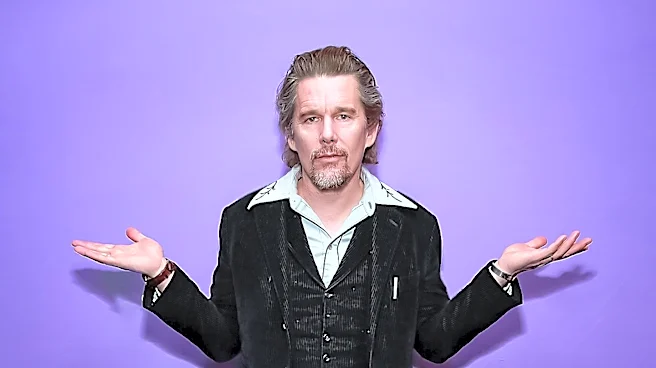
Ethan Hawke has revealed that Richard Linklater’s 2001 drama 'Tape' was the film role that most significantly impacted his life and career. Despite having worked in both independent cinema and major Hollywood productions since the age of 14, and earning
four Academy Award nominations, Hawke singled out this low-budget thriller during an interview with the BBC. He described 'Tape' as his "entrance to adult acting," noting that the project came as he was approaching 30 and transitioning into a new phase of his career. The film, which also starred his then-wife Uma Thurman and former 'Dead Poets Society' co-star Robert Sean Leonard, was shot in just six days using handheld digital video cameras. Hawke emphasized that the unique, fast-paced production method fostered a highly focused and collaborative environment, giving him considerable confidence and deepening his creative partnership with Linklater.
Why It's Important?
Ethan Hawke's reflection on 'Tape' highlights the profound impact that specific roles and production experiences can have on an actor's development and career trajectory. His statement underscores that not all career-defining moments come from high-profile, big-budget productions; sometimes, it's the challenging, intimate projects that foster significant personal and professional growth. For the U.S. film industry, this perspective emphasizes the value of independent cinema and experimental filmmaking techniques, such as the digital, six-day shoot of 'Tape.' It suggests that such projects can be crucial proving grounds for talent, allowing actors to explore new dimensions of their craft and build lasting creative relationships. This insight could encourage emerging filmmakers and actors to pursue projects that prioritize artistic challenge and collaboration over immediate commercial success, potentially enriching the diversity and depth of American cinematic output.
What's Next?
Hawke's continued emphasis on the artistic and personal growth derived from projects like 'Tape' suggests a sustained commitment to diverse and challenging roles throughout his career. This philosophy is likely to influence his future project selections, potentially leading him to balance mainstream success with more independent or experimental ventures. For the film industry, his public acknowledgment of 'Tape's' significance might draw renewed attention to the film itself and to the work of Richard Linklater, potentially inspiring new audiences and filmmakers to explore their collaborative history. This could also encourage a broader appreciation for the creative processes involved in low-budget, high-intensity productions, fostering an environment where artistic integrity and personal development are highly valued alongside commercial viability.
Beyond the Headlines
Ethan Hawke's candid reflection on 'Tape' delves into the deeper psychological and artistic dimensions of an actor's career. It reveals that true professional fulfillment often stems from experiences that challenge and transform one's understanding of their craft, rather than solely from accolades or financial success. The film's setting, confined to a single motel room, and its intense subject matter—an alleged sexual assault—underscore the power of minimalist storytelling to explore complex human dynamics. This choice of a 'life-changing' role speaks to the ethical and emotional weight actors carry, particularly when portraying difficult themes. It also highlights the symbiotic relationship between actor and director, where trust and shared vision can unlock profound performances. This narrative reinforces the idea that art, at its core, is a journey of self-discovery and continuous evolution, both for the creator and the audience.