




What's Happening?
AMD has acquired World Labs, a company founded by Fei-Fei Li in January 2024, for $8 billion. The acquisition, announced in September 2026, includes Li joining AMD as chief scientist, alongside co-founders Ben Mildenhall and Justin Johnson. World Labs developed
the 'Atlas' world model, an autoregressive diffusion transformer that generates new views of a world using 'next view prediction.' This model evolved from an earlier version called 'Marble,' which faced quality bottlenecks due to its direct prediction of 3D Gaussian splat representations. Atlas was trained from scratch and demonstrated its capability in July 2026 by reconstructing 3D scenes from just three iPhone videos for a real-to-sim-to-real robotics pipeline. The company indicates that current scaling limitations are primarily due to compute resources rather than data availability.
Why It's Important?
This acquisition signifies AMD's strategic move to bolster its position in the rapidly evolving artificial intelligence landscape, particularly in the domain of world models and generative AI. By integrating World Labs' advanced technology and expertise, AMD aims to enhance its AI capabilities, potentially leading to more sophisticated hardware-software integrations for AI applications. Fei-Fei Li's appointment as chief scientist brings a highly respected figure in AI research to AMD's leadership, which could attract further talent and innovation. The development of world models like Atlas, capable of generating realistic 3D scenes from limited input, has significant implications for robotics, virtual reality, and other industries requiring advanced environmental understanding and simulation. This could give AMD a competitive edge in providing comprehensive AI solutions.
What's Next?
Following the acquisition, AMD is expected to integrate World Labs' Atlas model and its underlying architecture into its existing AI development and product lines. This could lead to new AMD products or services that leverage advanced world modeling capabilities, potentially impacting sectors such as autonomous systems, gaming, and professional visualization. The expertise of Fei-Fei Li and her team will likely be directed towards further innovation in AI, potentially influencing AMD's long-term research and development roadmap. The focus on compute as the primary bottleneck for scaling suggests that AMD will likely prioritize optimizing its hardware to support the intensive computational demands of such advanced AI models, potentially driving advancements in GPU and processor technologies.
Beyond the Headlines
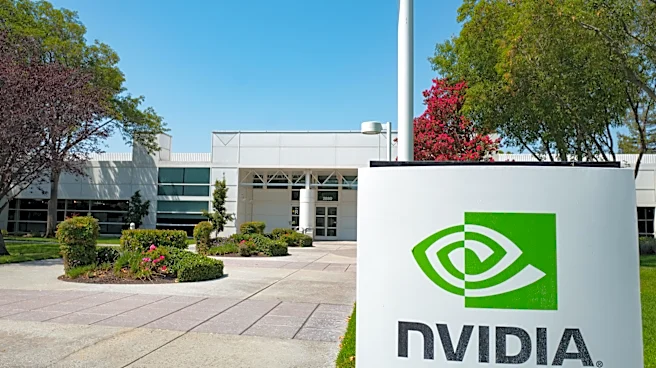
The acquisition highlights a broader trend in the technology industry where major hardware manufacturers are increasingly investing in AI software and research firms to create more integrated and powerful AI ecosystems. This move by AMD could intensify competition with other tech giants that are also heavily investing in AI, such as NVIDIA and Intel. The 'next view prediction' approach used by Atlas represents a significant architectural shift in generative modeling, moving away from explicit 3D representations towards implicit internal states, which could influence future AI model designs. Furthermore, the successful application of Atlas in robotics pipelines underscores the growing convergence of AI research with practical industrial applications, potentially accelerating the development of more intelligent and autonomous robotic systems.