


What's Happening?
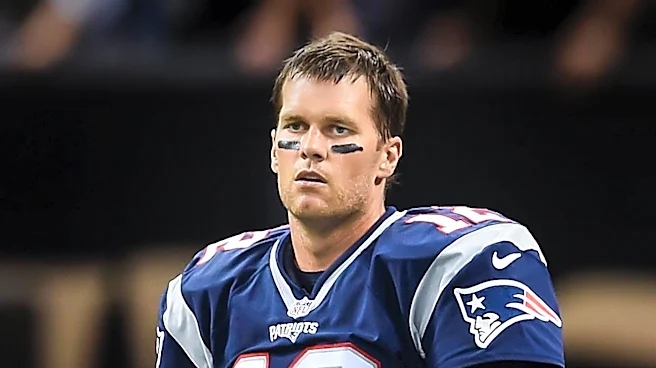
Seven-time Super Bowl champion Tom Brady has voiced his disapproval of the growing trend among established NFL players to sit out preseason games. Brady took to Instagram to repost an old clip from an August 26, 2010 preseason game against the then-St.
Louis Rams, where he played deep into the fourth quarter. In the game, Brady completed 18 of 22 passes for 273 yards and three touchdowns, achieving a perfect 158.0 passer rating. He emphasized his belief that 'Practice makes perfect' and stated, 'Too many people looking for easy ways out these days.' At the time of the 2010 game, Brady already had three Super Bowl rings and two Super Bowl MVP awards, indicating he had little left to prove regarding his roster spot. His comments suggest a strong stance against players prioritizing safety over game experience, even in exhibition matches.
Why It's Important?
Brady's comments highlight a significant debate within the NFL regarding player safety versus game readiness and competitive integrity. The league's shift to a 17-game regular season has intensified concerns about player health, leading many coaches to rest star players during the preseason to minimize injury risks. This practice, while seemingly logical for protecting multi-million dollar investments, is now being challenged by one of the sport's most decorated figures. Brady's perspective, rooted in his extensive experience and success, suggests that skipping preseason games might hinder a player's development or readiness, potentially impacting team performance. His remarks could influence younger players' attitudes towards preseason participation and spark further discussion among coaches, team owners, and the NFL Players Association about the optimal balance between player welfare and competitive preparation. The debate also touches on the broader work ethic and commitment expected from professional athletes.
What's Next?
Brady's comments are likely to fuel ongoing discussions within the NFL community about the value and necessity of preseason games for star players. While coaches and team management will continue to weigh the risks of injury against the benefits of game-time experience, Brady's strong stance might prompt some players to reconsider their approach to preseason participation. It could also lead to further dialogue among the NFL Players Association and the league regarding potential adjustments to preseason formats or player compensation to incentivize participation. The debate may also extend to media coverage, with analysts and former players offering their perspectives on whether resting stars is a prudent strategy or a sign of declining competitive drive. Ultimately, the league will need to balance player safety concerns with the desire to maintain a high level of competition and preparation throughout the season.
Beyond the Headlines
Beyond the immediate debate over preseason games, Brady's remarks touch upon a broader cultural shift in professional sports concerning athlete management and the perception of 'toughness.' His 'practice makes perfect' philosophy harks back to an older era of sports where playing through minor discomforts and maximizing every opportunity for preparation was highly valued. In contrast, modern sports emphasize advanced sports science, injury prevention, and strategic rest to prolong careers. This clash of philosophies reflects a generational divide in how athletes approach their careers and how organizations manage their talent. Brady's statement could be interpreted as a critique of a perceived 'softening' in the league, raising questions about whether the pursuit of longevity and injury avoidance might inadvertently diminish the competitive edge or the development of resilience among players. It also highlights the evolving understanding of an athlete's 'job' in a high-stakes, high-injury-risk environment.