





What's Happening?
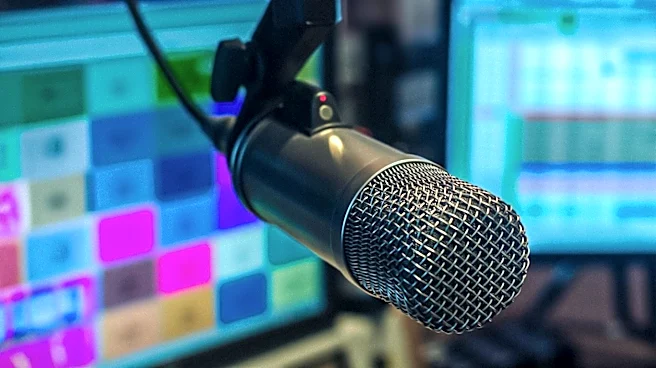
Beatline Sports is producing AI-generated podcasts covering major American sports teams, a practice that has drawn criticism for significant factual inaccuracies. According to a report, these AI-driven podcasts have misidentified players, misstated ages,
and confused players between different teams. For instance, hockey player Dylan Guenther was incorrectly referred to as 'Dylan Gooner,' and members of the San Jose Sharks were mistakenly identified as players for the Utah Mammoth. Additionally, Liam O'Brien, who is 32, was described as a 'young player,' potentially confusing him with Jake O'Brien. These errors extend to other sports media, with ESPN's John Buccigross acknowledging the use of AI for commentary in NHL 27, where player names like Joel Kiviranta, Martin Necas, and Eric Lindros have been mispronounced. The prevalence of these errors in AI-generated content raises concerns about the reliability and quality of automated sports coverage.
Why It's Important?
The emergence of AI-generated sports content with significant factual errors has several important implications for the sports media landscape and its consumers. Firstly, it erodes trust in sports reporting, as fans rely on accurate information regarding players, teams, and game details. Inaccurate reporting can lead to misinformation among the audience and diminish the credibility of the platforms producing such content. Secondly, it highlights the current limitations of AI in nuanced tasks like sports commentary, which often requires a deep understanding of context, player histories, and real-time events beyond simple data processing. The misidentification of players and factual errors suggest that current AI models may lack the sophistication to replace human journalists and commentators effectively. Lastly, this trend raises questions about the future of sports journalism and the potential displacement of human talent by automated systems that, in their current state, deliver a subpar product, impacting the livelihoods of professional sports reporters and commentators.
What's Next?
The ongoing issues with AI-generated sports content may prompt a reevaluation of its deployment in media. Sports organizations and media outlets might face increased pressure from fans and critics to either improve the accuracy of AI-driven commentary and reporting or scale back its use. There could be a push for more robust human oversight and editing processes for AI-generated content to catch and correct errors before publication. Furthermore, the backlash might encourage developers of AI sports commentary tools to invest more heavily in refining their algorithms, focusing on natural language processing and contextual understanding to minimize factual mistakes and mispronunciations. This could lead to a hybrid approach where AI assists human journalists rather than fully replacing them, ensuring a higher standard of accuracy and quality in sports media.
Beyond the Headlines
The debate over AI in sports coverage extends beyond mere factual errors to deeper ethical and professional considerations. The increasing reliance on AI for content creation raises questions about the value of human expertise, passion, and storytelling in sports journalism. Human reporters often bring unique insights, personal connections, and narrative depth that AI currently cannot replicate. The perceived 'generational garbage' produced by some AI systems underscores a broader concern about the commodification of content at the expense of quality and authenticity. This trend could lead to a devaluation of journalistic integrity and a shift towards quantity over quality in media production. Moreover, the displacement of human jobs by flawed AI systems sparks discussions about the societal impact of automation and the need for ethical guidelines in AI development and deployment, particularly in creative and interpretive fields like sports commentary.