







What's Happening?
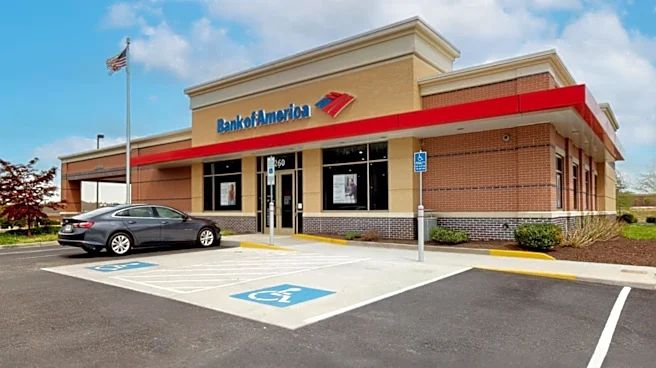
On October 13, 2026, the U.S. Department of the Treasury announced penalties exceeding $1.21 billion against Bank of America for widespread anti-money laundering (AML) and sanctions violations. This marks the third-largest penalty in the Treasury's history,
with the Office of the Comptroller of the Currency (OCC) imposing its largest-ever penalty as part of this action. The penalties stem from three coordinated actions by the Financial Crimes Enforcement Network (FinCEN), the OCC, and the Office of Foreign Assets Control (OFAC). FinCEN assessed a $1.2 billion civil money penalty for the bank's failure to mitigate and report priority national security risks, including Chinese money laundering networks and illicit finance along the U.S. southwest border. The OCC imposed a $750 million civil money penalty for a deficient and ineffective Bank Secrecy Act (BSA)/AML compliance program, which was credited against the FinCEN penalty. Additionally, OFAC reached an $11.66 million settlement for 475 apparent violations of sanctions programs related to Russia, Belarus, Iran, Burma, Somalia, narcotics, and global terrorism between September 2021 and April 2025.
Why It's Important?
This substantial penalty against Bank of America underscores the U.S. government's stringent enforcement of AML and sanctions compliance, signaling that regulators expect integrated and proactive measures from financial institutions. The scale of the fine, particularly against one of the largest banks in the U.S., highlights that size and sophistication do not exempt institutions from severe consequences when compliance controls fail. For the broader U.S. financial industry, this serves as a critical wake-up call, emphasizing the need for robust and effective compliance programs that are not merely theoretical but function effectively in practice. The Treasury's statement that AML and sanctions efforts should be 'effectively integrated and mutually reinforcing' sets a clear expectation for how financial institutions must manage these risks. Failures in this area can lead to significant financial losses, reputational damage, and increased regulatory scrutiny across the sector.
What's Next?
Bank of America is now required to undertake a third-party lookback to identify and report previously undetected suspicious transactions, along with independent reviews of its suspicious activity monitoring, customer due diligence, correspondent account due diligence, and data governance. These remedial requirements indicate a long-term commitment to overhauling and strengthening its compliance infrastructure. The Treasury's promotion of FinCEN's whistleblower incentive program suggests that future compliance issues could be brought to light by employees, adding another layer of oversight for financial institutions. This enforcement action will likely prompt other U.S. banks to review and enhance their own AML and sanctions compliance programs to avoid similar penalties. The ongoing scrutiny from regulators means that financial institutions must continuously adapt and improve their controls to meet evolving compliance standards and mitigate financial crime risks.
Beyond the Headlines
The Bank of America penalty reveals deeper systemic issues regarding the effectiveness of compliance programs within large financial institutions. The findings indicate that the bank relied heavily on external inquiries rather than its own internal controls for proactive detection, and that suspicious activity was often left uninvestigated for extended periods. This highlights a critical flaw where compliance might be treated as a reactive measure rather than an integral, proactive component of operations. The OFAC violations, stemming from human error, technical failures, and delayed fixes, further emphasize that even sophisticated systems can fail without adequate training, timely updates, and a culture of compliance. This case serves as a stark reminder that effective compliance requires continuous investment in technology, skilled personnel, and a robust internal audit function, rather than just a paper-based program. The integration of AML and sanctions efforts is crucial, as regulators will no longer tolerate siloed approaches that create blind spots for illicit finance.