




What's Happening?
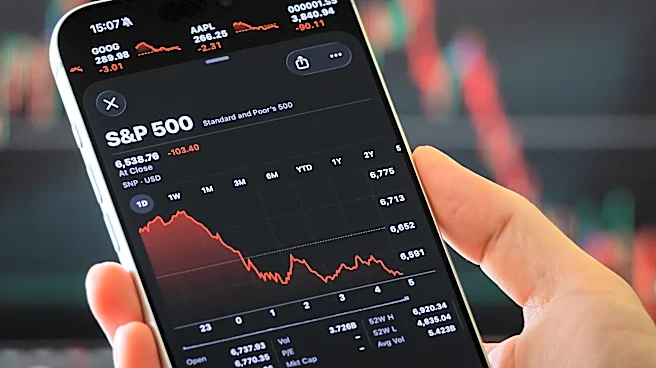
Tom Lee, Head of Research and CIO of Fundstrat Capital, has asserted that the S&P 500 is currently 'quite cheap' following a recent market selloff. Lee's assessment directly counters warnings from Citadel Securities strategists who drew parallels between
the current market conditions in 2026 and those of late 2018. Citadel strategists suggested a darkening growth outlook due to the Federal Reserve's hawkish stance and a potential slowdown in the AI-driven investment cycle. Lee, however, argues that 2026 differs significantly from 2018, primarily due to the presence of a strong artificial intelligence (AI) narrative. He acknowledges similarities such as Federal Reserve tightening, a midterm election year, and a 10% decline in stocks, but emphasizes that 2018 lacked a positive driver like AI. Lee believes the market is experiencing an AI 'supply shock' rather than an 'end cycle' risk, citing AI policy risks, cautious debt markets, and Federal Reserve risks, while maintaining that demand for AI remains robust.
Why It's Important?
This divergence in expert opinion from prominent financial figures like Tom Lee and Citadel Securities strategists holds significant implications for U.S. investors and the broader economy. Lee's optimistic outlook on the S&P 500's valuation, labeling it 'quite cheap,' could encourage investment and potentially stabilize or boost market confidence. His argument that the AI sector is facing a 'supply shock' rather than an 'end cycle' risk suggests that the current market downturn might be a temporary hurdle for a fundamentally strong growth area. Conversely, Citadel's warning of a darkening growth outlook and a potential collision between Federal Reserve policy and the AI investment cycle could lead to increased caution among investors, potentially dampening market enthusiasm and investment in technology. The differing interpretations of the AI market's health will influence investment strategies, particularly in the technology and semiconductor sectors, which Lee notes are trading at historically low multiples.
What's Next?
The market will likely continue to monitor the Federal Reserve's policy decisions and their impact on inflation and interest rates, as both Lee and Citadel acknowledge the Fed's influence. Investors will also closely watch developments in the AI sector to determine whether the current challenges are indeed a 'supply shock' that will eventually resolve, or if they signal a more fundamental slowdown. Lee anticipates 'less downside into year-end' and a positive risk-reward profile for the coming months, suggesting a potential rebound. However, the 'technical damage to stocks' he mentions indicates that volatility may persist in the short term. The performance of the Nasdaq 100, S&P 500, and Dow Jones indices in the coming weeks will be crucial indicators of which perspective—Lee's or Citadel's—proves more accurate. The ongoing debate about AI's long-term trajectory and its susceptibility to economic headwinds will shape investment decisions and market sentiment.
Beyond the Headlines
The contrasting views on the market's health and the role of AI highlight a deeper tension within financial analysis: the balance between fundamental valuation and market perception. Lee's assertion that 'perception is 9/10 of markets' underscores how investor sentiment, even when detached from underlying fundamentals, can significantly influence market movements. The current situation also brings to light the evolving nature of economic cycles in an era dominated by rapid technological advancements like AI. The question of whether AI represents a new, sustained growth engine or is susceptible to traditional economic downturns is central to this debate. Furthermore, the discussion touches upon the potential for 'supply shocks' in high-growth sectors, where demand outstrips the ability to produce, leading to temporary price and valuation adjustments. This scenario could prompt discussions about industrial policy, supply chain resilience, and the role of government in fostering technological innovation while mitigating risks.