





What's Happening?
AMD has announced the mass production of its second-generation Helios AI servers, with shipments expected to begin by the end of the third quarter. The Helios servers are equipped with the latest MI455X AI accelerator and the new Venice central processor,
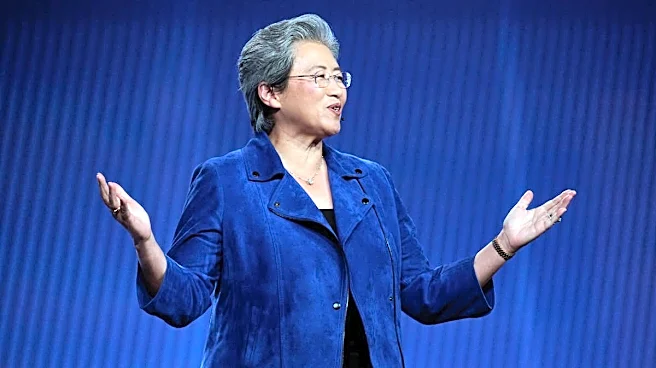
developed in collaboration with Taiwan Semiconductor Manufacturing Co. During a speech in San Francisco, AMD CEO Lisa Su highlighted the strong customer demand for Helios, which is designed to enhance AMD's position in the data-center market, particularly in inference computing tasks. OpenAI, known for creating ChatGPT, plans to adopt Helios racks this year, as stated by Sachin Katti, OpenAI's Vice President of Computational Strategy. AMD projects the total data-processing market could reach $2 trillion by 2030, with significant growth in the AI accelerator segment.
Why It's Important?
The introduction of AMD's Helios AI servers marks a significant development in the competitive landscape of AI hardware, particularly in the data-center market. As AI applications continue to expand, the demand for efficient and powerful computing solutions is increasing. AMD's move to mass-produce Helios servers positions the company to capture a larger share of the growing market for AI accelerators and CPUs, challenging established players like Intel and Nvidia. The collaboration with OpenAI and other cloud service providers underscores the importance of partnerships in advancing AI infrastructure. This development could lead to increased competition and innovation in AI computing, potentially driving down costs and accelerating the deployment of AI technologies across various industries.
What's Next?
As AMD begins shipping Helios AI servers, the company is likely to focus on expanding its partnerships with major AI firms and cloud service providers. The collaboration with OpenAI is expected to bring significant revenue and strategic benefits, as OpenAI plans to use AMD's next-generation MI500 chips. The competition among major players in the AI hardware space is expected to intensify, with companies vying for dominance in the inference-compute power market. This could lead to further advancements in AI technology and infrastructure, shaping the future of data centers and AI applications.