






What's Happening?
During a live interview on The Hill: Rising, investor Kevin O'Leary initially stated there was 'zero' chance of Jensen Huang returning as Nvidia's CEO. O'Leary cited ongoing SEC and other security agency investigations into Huang, suggesting these probes
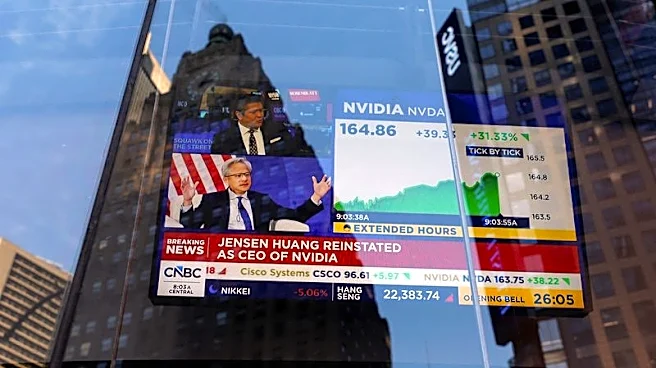
would prevent his reinstatement for at least two years. He also commented on the market's negative reaction to Huang's initial resignation, interpreting it as a 'correction' that closed the 'Bank of Nvidia,' which he believed was involved in circular leverage for AI data center build-out and chip purchases. O'Leary maintained that despite the stock being 'crushed,' Nvidia's fundamentals remained solid, with demand for its chips persisting. He even suggested that domestic and international customers would fill any gap created by potential export curbs to China, which he estimated accounted for 20% of chip imports. However, mid-interview, the host, Robby Soave, announced that Nvidia had reinstated Jensen Huang as CEO, effective immediately, directly contradicting O'Leary's prediction.
Why It's Important?
This event highlights the unpredictable nature of corporate leadership decisions, especially for major technology companies like Nvidia, which plays a critical role in the AI and semiconductor industries. O'Leary's initial assessment reflected a common perception that ongoing investigations would preclude a CEO's return, underscoring the market's sensitivity to regulatory scrutiny and corporate governance. The immediate reinstatement of Jensen Huang, despite the ongoing SEC investigations, suggests a strong vote of confidence from Nvidia's board in his leadership and the company's ability to navigate regulatory challenges while maintaining its strategic direction. This decision could influence investor confidence and market perceptions regarding the stability and future trajectory of Nvidia, a key player in the U.S. technology sector. It also demonstrates the rapid pace at which news and corporate developments can unfold, impacting expert analysis and public commentary.
What's Next?
Following Jensen Huang's immediate reinstatement as CEO, Nvidia's board has affirmed its cooperation with ongoing government investigations and inquiries. The company is also initiating a search for a new Chief Compliance Officer, who will oversee compliance across Nvidia and report to the Nominating and Corporate Governance Committee. This move indicates a proactive approach to addressing regulatory concerns and strengthening corporate governance in light of the investigations. Kevin O'Leary speculated that the company would continue under investigation with Huang as CEO, describing it as an 'unprecedented reversal.' The market will likely closely watch how Nvidia manages these investigations while Huang leads the company, particularly concerning any potential impact on its operations, stock performance, and strategic initiatives in the competitive AI and semiconductor landscape. The appointment of a Chief Compliance Officer suggests a commitment to transparency and adherence to regulatory standards moving forward.
Beyond the Headlines
The rapid reinstatement of Jensen Huang as Nvidia's CEO, despite ongoing SEC investigations, raises deeper questions about corporate accountability, the influence of key leaders, and the balance between market confidence and regulatory compliance. O'Leary's initial comparison of Huang's approach to Steve Jobs suggests a perception of indispensable leadership, where a founder's vision is seen as critical to a company's success, even amidst controversy. The board's decision to reinstate Huang, while simultaneously creating a new Chief Compliance Officer role, indicates a strategy to mitigate risks and address governance concerns without sacrificing what they perceive as essential leadership. This scenario could set a precedent for how major tech companies handle leadership transitions and regulatory challenges, potentially influencing corporate governance practices across the industry. It also highlights the dynamic interplay between public perception, expert commentary, and the swift, often unexpected, realities of corporate decision-making.