



What's Happening?
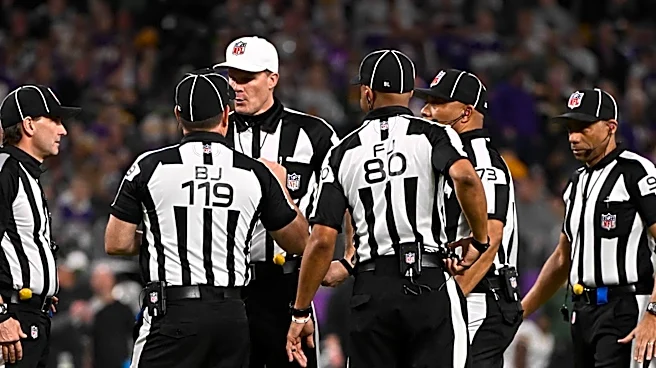
The National Football League (NFL) has acknowledged a significant officiating error during a recent game between the Dallas Cowboys and the Tampa Bay Buccaneers. The mistake involved a penalty for illegal hands to the face, which was incorrectly assessed
against Buccaneers defensive lineman Calijah Kancey. According to NFL officiating and rules analyst Walt Anderson, the foul was actually committed by Cowboys guard Tyler Booker. The incident occurred in the second quarter with approximately three minutes remaining, while the score was tied 7-7 and the Cowboys were on 1st-and-10 at their own 13-yard line. The incorrect call resulted in a five-yard penalty against Tampa Bay and an automatic first down for Dallas, despite Kancey's apparent frustration and protestations to the referee on the field. The NFL's weekly officiating review confirmed that the action was by the offensive player, not the defensive player.
Why It's Important?
This officiating error highlights ongoing concerns regarding accuracy and accountability in NFL game management. While the penalty did not ultimately affect the game's outcome—the Buccaneers, who were winless at the time, went on to win 24-16—it underscores how incorrect calls can unfairly impact team momentum and strategic play. The league's admission, while transparent, does not provide a remedy for the affected team, as game results are not typically overturned. This incident, alongside a similar recent controversy involving the Los Angeles Rams, raises questions about the effectiveness of real-time officiating and the process for correcting clear errors during play. It also puts a spotlight on the NFL's evaluation process for officials, as such errors can influence future assignments, particularly for postseason games.
What's Next?
As of now, there is no publicly announced remedy or change to the game's outcome for the Tampa Bay Buccaneers. The NFL's weekly review process, while identifying errors, does not automatically lead to the reopening of completed games or result reversals. The league's primary response to such incidents involves evaluating officials' performance, with supervisors providing feedback to crews. These evaluations can impact officials' future assignments, including eligibility for postseason games. However, there has been no public confirmation of any specific disciplinary action taken against the officials involved in this particular error. The incident may fuel further discussions within the league's Competition Committee regarding the use of objective information and potential in-game assistance to verify player numbers and prevent similar misidentifications.
Beyond the Headlines
The repeated instances of admitted officiating errors, such as the one involving Tyler Booker and Calijah Kancey, contribute to a broader narrative about the integrity and fairness of professional sports. While the NFL has mechanisms for review and evaluation, the inability to correct significant in-game errors retrospectively can lead to frustration among teams and fans. This situation also touches upon the ethical dimension of sports officiating, where the pursuit of accuracy is paramount, yet human error remains a factor. The distinction between offensive and defensive illegal hands to the face penalties, as outlined in the NFL rulebook, further complicates matters, emphasizing the need for precise identification of the offending player. The ongoing challenge for the NFL is to balance the speed of live game action with the demand for flawless officiating, potentially leading to future rule adjustments or technological advancements to aid referees.