





What's Happening?
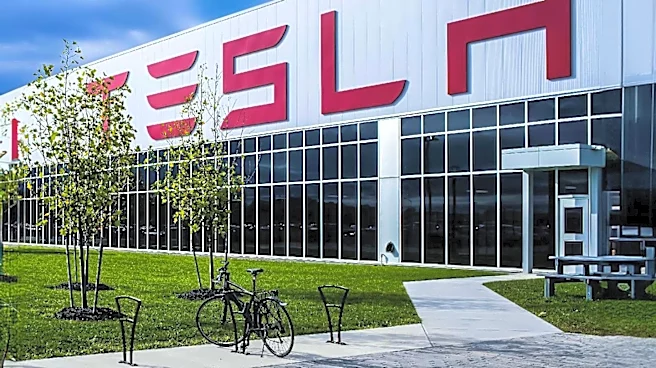
Tesla is evaluating Fort Bend County, Texas, as a potential site for a $10.1 billion solar cell and module manufacturing facility, with operations projected to begin in early 2029. This proposed development, known as Project Crystal Sun, aims to significantly
expand Tesla’s domestic solar manufacturing capabilities. The facility would produce photovoltaic cells and assembled solar modules for utility-scale, commercial, and residential markets. Tesla has indicated that the project could create 9,712 full-time jobs and over 1,000 construction roles. The company is actively seeking property tax relief through the Texas Jobs, Energy, Technology and Innovation Act (JETI) to make the Texas location competitive against other potential sites. This initiative is part of a broader strategy by Tesla to increase its investment in energy infrastructure, including solar and battery technologies, to meet rising electricity demand.
Why It's Important?
This potential investment by Tesla is significant for the U.S. clean energy sector, as it would inject substantial capital into the domestic solar manufacturing pipeline. The project highlights the increasing role of state tax policies and incentives in attracting large-scale advanced manufacturing investments, particularly in industries critical for energy security and electrification. By expanding its U.S. solar manufacturing footprint, Tesla aims to gain greater control over its supply chain, reduce production costs, and advance its technology, thereby addressing the current concentration of solar manufacturing in China. The move also underscores the growing connection between energy, industrial policy, and the escalating electricity demand driven by advancements in transport electrification and artificial intelligence. This investment could bolster U.S. competitiveness in the global solar market and create a significant number of high-tech jobs.
What's Next?
Tesla has not yet made a final commitment to Fort Bend County, as it is evaluating several U.S. locations. The decision will largely depend on the finalization of an incentive package, particularly the property tax relief sought through the Texas JETI program. If the Texas site is selected, construction could commence in 2026, with commercial operations targeted for the first quarter of 2029. The outcome of these negotiations will influence the scale of U.S. investment in solar manufacturing and its ability to compete with established Asian supply chains. Major stakeholders, including state and local governments, clean energy investors, and the broader manufacturing sector, will be closely watching the resolution of the location and incentive package.
Beyond the Headlines
The proposed Tesla solar manufacturing facility in Texas reflects a deeper trend of industrial policy aimed at localizing critical supply chains and enhancing energy independence. The emphasis on state incentives, such as the JETI program, highlights a competitive landscape among U.S. states to attract high-value manufacturing, often driven by strategic national interests in clean energy and advanced technology. This initiative also brings to the forefront the challenge of balancing economic development with environmental sustainability, as large-scale manufacturing projects require significant resources and infrastructure. Furthermore, the project's success could serve as a model for other companies looking to onshore production, potentially leading to a broader revitalization of U.S. manufacturing in key sectors and reducing reliance on foreign supply chains.