
What's Happening?
A group of 26 University of Mississippi business students participated in a three-week study abroad program in Iceland from August 1-20. The program focused on how tourism and sustainable energy practices
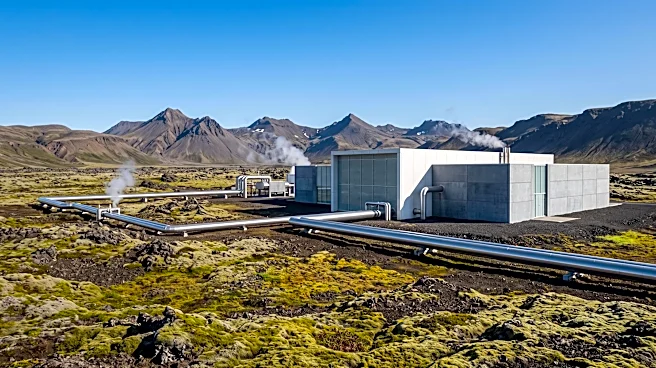
coexist and drive Iceland's economy. Students visited various natural landmarks and businesses, including the Srokkur geyser, ON Power (a geothermal energy utility), EIMskip (a transportation company), the Iceland Ocean Cluster, Thingvellir National Park, and the Blue Lagoon. The trip provided hands-on learning experiences, allowing students to observe real-world applications of supply chain management and international business concepts, with a particular emphasis on sustainability efforts by Icelandic companies. Academic adviser Kim Phillips noted the diverse landscape, while student Olivia Dyer found the companies' commitment to sustainability inspiring.
Why It's Important?
This study abroad program offers significant educational value by providing U.S. business students with direct exposure to a leading model of sustainable economic development. Iceland's approach to integrating natural resources with business operations, particularly in tourism and geothermal energy, presents a unique case study for future business leaders. Understanding how companies prioritize sustainability, even with additional costs and effort, can influence students' perspectives on corporate responsibility and innovation. The experience bridges theoretical classroom knowledge with practical, international business challenges, preparing students for a globalized economy where environmental considerations are increasingly paramount. This type of experiential learning can foster a generation of business professionals more attuned to sustainable practices and international collaboration.
What's Next?
The students have concluded their study abroad experience, returning to the University of Mississippi with enhanced perspectives on sustainable business and international operations. The insights gained from observing Iceland's economy could influence their academic pursuits and future career choices, potentially leading to more graduates pursuing roles in sustainable industries or international business. The University of Mississippi may continue to offer similar programs, leveraging the success of this trip to provide ongoing global learning opportunities for its students. The experience could also inspire further research or case studies within the School of Business Administration on the intersection of business, tourism, and sustainability.
Beyond the Headlines
The trip highlights a growing trend in business education towards experiential learning and global immersion, recognizing that real-world exposure is crucial for developing well-rounded professionals. Iceland serves as an excellent example of how a nation can leverage its unique natural environment for economic growth while striving for sustainability, offering lessons applicable to other countries and industries. The students' observations about the interconnectedness of business, tourism, sustainability, and national identity underscore the complex interplay of these factors in modern economies. This kind of international exposure can broaden students' horizons, making them more adaptable and globally aware, which is essential in an increasingly interconnected world.