







What's Happening?
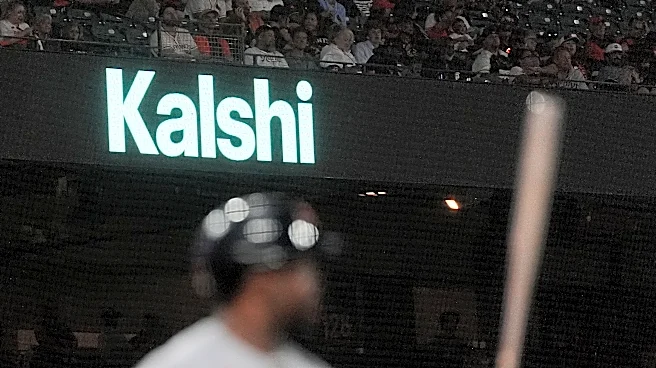
The state of Utah has requested a court to dismiss criminal charges against prediction market operator Kalshi and its co-founders, CEO Tarek Mansour and COO Luana Lopes Lara. This development follows Kalshi's decision to halt trading activities within
Utah. The charges, filed last month, included 13 felony counts of violating the state's gambling prohibition and one charge related to profiting from illegal activity. Utah's Attorney General Derek Brown cited a 'change in circumstance' for the motion, indicating that the case could be refiled if Kalshi resumes operations in the state. Utah considers prediction markets as gambling, a stance shared by many other states regarding sports trading activities. Kalshi, the largest prediction market operator in the U.S., had previously stated it would continue to fight for its right to operate in Utah, despite halting trading after a federal judge did not immediately stop Utah's enforcement attempts.
Why It's Important?
This situation highlights the ongoing regulatory battle between states and the federal government over the classification and oversight of prediction markets. Utah's felony charges represented an aggressive tactic by a state to assert regulatory authority over this rapidly expanding industry. The fragmented legal landscape, with litigation spread across more than 20 states, suggests that the issue may ultimately be decided by the U.S. Supreme Court. For Kalshi, the halt in trading in Utah, and partially in Michigan, Nevada, and Washington, impacts its operational reach and revenue. The outcome of these legal challenges will set precedents for how prediction markets are regulated nationwide, potentially influencing their growth and accessibility. The case also underscores the differing interpretations of whether prediction markets constitute financial exchanges or illegal gambling, a distinction with significant implications for both operators and users.
What's Next?
A Salt Lake City-based court will now consider Utah's motion to dismiss the charges against Kalshi and its executives. While the immediate criminal charges may be dropped, the underlying legal dispute regarding Kalshi's right to operate in Utah remains. Kalshi has an appeal pending after a federal judge rejected its request to prevent Utah from enforcing its gambling restrictions. The company has indicated its intention to continue fighting in court for the right to operate in Utah. The broader conflict over federal versus state regulation of prediction markets is expected to continue, with analysts suggesting a potential resolution by the U.S. Supreme Court. The Commodity Futures Trading Commission (CFTC) and Kalshi argue that prediction markets offer 'event contracts' that should be regulated as swaps under federal law, a view opposed by Utah and at least 44 other states.
Beyond the Headlines
The legal battle surrounding Kalshi and prediction markets delves into fundamental questions about the nature of financial innovation and regulatory frameworks. The debate over whether prediction markets are akin to financial exchanges or gambling has significant implications for consumer protection, market integrity, and economic freedom. If prediction markets are ultimately classified as gambling, they could face stringent state-level prohibitions and regulations, limiting their potential as tools for hedging or information aggregation. Conversely, if they are recognized as legitimate financial instruments, it could pave the way for a more unified federal regulatory approach, fostering innovation and potentially creating new avenues for risk management and economic forecasting. The outcome will also influence the balance of power between state and federal authorities in regulating emerging financial technologies, setting a precedent for future innovations that blur traditional definitional lines.