







What's Happening?
Ecuador's state oil company, EP Petroecuador, has announced a new strategic plan aimed at increasing oil production and reserves, enhancing energy self-sufficiency, and developing natural gas resources. The company plans to implement 10 electricity generation
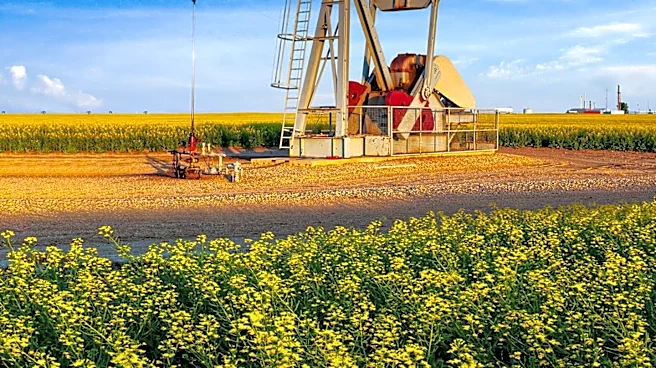
projects, which are expected to add over 120 megawatts (MW) to its energy demand between 2026 and 2028. This initiative prioritizes the reduction of gas flaring and the increased utilization of associated gas to optimize generation costs. Petroecuador also intends to double the use of associated gas for self-generation in the Amazon region and boost offshore natural gas production from the Amistad Field. The goal for oil production is to average around 375,000 barrels per day in September, potentially reaching peaks of 380,000 barrels, achieved through optimizing reconditioning and drilling plans. The strategy also focuses on maintaining fuel supply for the national market and transforming Petroecuador into a more reliable national and international partner.
Why It's Important?
This strategic shift by Petroecuador is significant for Ecuador's energy sector and national economy. By focusing on energy self-sufficiency and natural gas development, the country aims to reduce its reliance on imported fuels, particularly diesel. The planned 120 MW of additional generation capacity, primarily from associated gas and crude, is projected to yield annual economic benefits of $240 million in 2026 by displacing 70 million gallons of diesel. By 2028, annual savings from diesel displacement are expected to exceed $300 million, as generation costs decrease from approximately $0.35/kWh for diesel to $0.10/kWh for associated gas. This move will not only lower operational costs for Petroecuador but also strengthen the company's energy resilience and operational reliability, particularly in exploration and production, where electrical failures have historically caused significant production losses. Furthermore, the initiative to reduce gas flaring aligns with environmental sustainability goals, aiming to prevent the emission of around 710,000 tons of CO2.
What's Next?
Petroecuador will proceed with the implementation of its 10 electricity generation projects, with an investment portfolio exceeding $300 million. These projects will be concentrated in strategic areas of the Amazonian district, including Blocks 61 Auca, 60 Sacha, and 57 Shushufindi, to support existing production and new activities aimed at increasing oil output. The company plans to increase its gas generation capacity to 45 MW, a 15% increase from 2025, and aims to double the use of associated gas in self-generation from 13 to 28 million cubic feet per day by 2028. Additionally, efforts are underway to boost non-associated natural gas production from the Amistad Field, with expectations to exceed 34 million cubic feet per day by October, doubling the volumes from February 2026. Petroecuador will also continue its transformation process, which includes valuing company assets, auditing financial statements, strengthening integrity, digitalizing administrative and control systems, and obtaining updated oil reserve certifications to attract further investments.
Beyond the Headlines
The emphasis on natural gas development marks a fundamental shift for Petroecuador, traditionally an oil-focused company. This transformation positions natural gas as a strategic asset with immense potential to reshape Ecuador's energy landscape. By converting associated gas, previously a byproduct, into a valuable resource for electricity generation, Petroecuador is addressing both economic and environmental concerns. This approach not only enhances the company's financial performance through cost savings and increased efficiency but also contributes to national sustainability goals by reducing greenhouse gas emissions. The strategy reflects a broader global trend among energy companies to diversify their portfolios and integrate cleaner energy sources, moving beyond a sole reliance on crude oil. This could set a precedent for other national oil companies in the region to adopt more sustainable and diversified energy strategies.