





What's Happening?
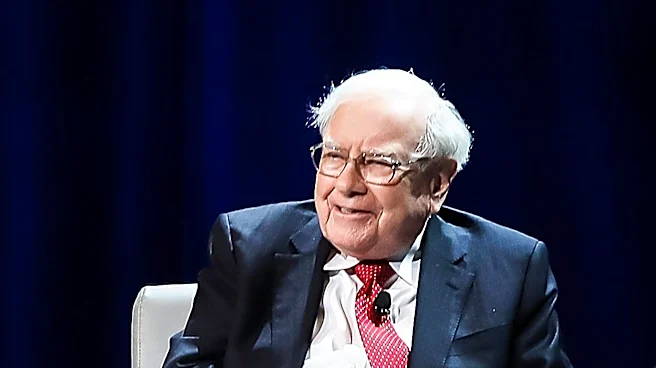
In November 2025, Warren Buffett penned his final Thanksgiving letter as CEO of Berkshire Hathaway, retiring at the age of 95. In this letter, he imparted a key piece of leadership advice: 'Keep in mind that the cleaning lady is as much a human being
as the Chairman.' This statement encapsulates a philosophy of humility and respect for all individuals, regardless of their position, which Buffett demonstrated throughout his career. The letter also reflected on his early investment in Berkshire Hathaway, a struggling textile maker, which he initially bought due to its cheap stock. Despite the company's eventual transformation into a $1 trillion conglomerate, Buffett maintained a modest lifestyle, taking a $100,000 salary for over 40 years, living in the same Omaha house since 1958, and donating over $66 billion to charity.
Why It's Important?
Warren Buffett's parting advice serves as a powerful reminder of ethical leadership in the business world, particularly in an era often criticized for corporate excess and a widening gap between executive and employee compensation. His emphasis on treating everyone with equal respect challenges the hierarchical norms prevalent in many corporations. This philosophy has broader implications for corporate culture, potentially fostering more inclusive and equitable workplaces. For U.S. businesses, adopting such principles could lead to improved employee morale, reduced turnover, and a stronger sense of community within organizations. It also highlights the enduring value of integrity and humility as foundational elements of long-term success, offering a counter-narrative to the often-singular focus on profit maximization.
What's Next?
While Warren Buffett has retired as CEO, his legacy and ethical principles are expected to continue influencing Berkshire Hathaway and the broader business community. His successor, Greg Abel, will likely face the challenge of upholding these values while navigating new investment strategies, such as the increased focus on AI. The impact of Buffett's advice may be seen in how future corporate leaders are trained and how companies prioritize employee welfare and ethical conduct. Business schools and leadership programs might increasingly incorporate his philosophy into their curricula, promoting a more human-centric approach to management. The long-term effect could be a gradual shift in corporate governance towards greater social responsibility and stakeholder consideration.
Beyond the Headlines
Warren Buffett's final message transcends typical business advice, touching upon fundamental human values. It underscores the idea that true leadership is not merely about financial acumen or strategic brilliance, but also about character and empathy. In a society grappling with issues of inequality and social justice, his words resonate as a call for greater humanity in all spheres, including the corporate world. This perspective suggests that sustainable success is intertwined with ethical behavior and a deep respect for every individual's contribution. It challenges the notion that business is solely a transactional endeavor, instead advocating for a more relational and compassionate approach that recognizes the inherent dignity of all people. This could inspire a cultural shift towards more conscious capitalism.