





What's Happening?
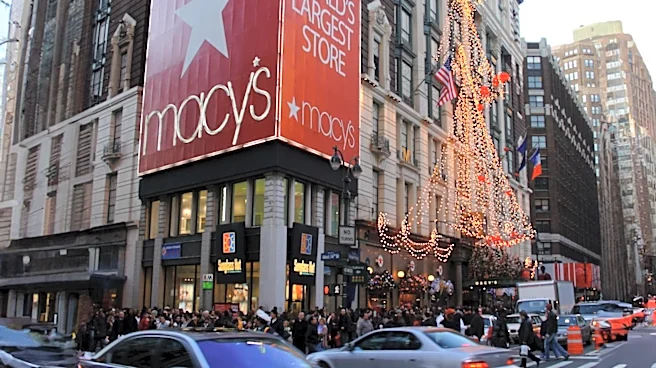
Macy's, Inc. executives announced at the Goldman Sachs Global Consumer and Retail Conference that their 'A Bold New Chapter' strategy is successfully driving sales growth, improving customer service metrics, and showing progress across its Macy's, Bloomingdale's,
and Bluemercury banners. Chairman and Chief Executive Officer Tony Spring stated that the company is approximately two and a half years into this strategy, which aims to enhance store productivity, close underperforming locations, strengthen luxury brands, and modernize operations. The company has seen growth in its 'Reimagine' stores for nine out of the last ten quarters and has recorded five consecutive quarters of growth for the Macy's banner. Additionally, Macy's has exceeded its guidance in six quarters. The 'Reimagine' program, which began with 50 stores and expanded to additional cohorts, now covers about 60% of Macy's stores and 75% of its store business. This program focuses on improvements in merchandising, product presentation, fitting rooms, staffing, store density, and price-point assortment. Chief Operating Officer and Chief Financial Officer Tom Edwards noted that these investments are capital-light, primarily focusing on employees, customer experience, events, and marketing, leading to sales gains and profitability improvements.
Why It's Important?
This strategic success for Macy's is significant for the U.S. retail sector, demonstrating how traditional department stores can adapt and thrive in a competitive and evolving market. The 'Bold New Chapter' strategy, with its focus on store productivity, luxury banners, and modernization, provides a blueprint for other legacy retailers facing similar challenges. The reported sales growth and improved customer satisfaction scores indicate a positive shift in consumer perception and engagement with Macy's brands. The emphasis on 'Reimagine' stores and omnichannel capabilities highlights the importance of integrating physical and digital retail experiences to meet modern consumer demands. Furthermore, the company's ability to exceed guidance and increase its full-year EPS outlook suggests a robust financial recovery and potential for sustained growth, which could influence investor confidence in the broader retail industry. The strategy's success also impacts employment within the retail sector, as investments in staffing and store experiences can lead to job creation and improved working conditions.
What's Next?
Macy's plans to continue its 'Reimagine' expansion, with additional store pilots being tested this year in preparation for further rollout in 2027. The company remains committed to a future Macy's store base of approximately 350 locations, having already closed about 85 stores during the first two years of its strategy. Investments will continue in omnichannel capabilities, faster delivery, and enhanced store experiences. Executives anticipate a potentially 'choppy' consumer environment due to macroeconomic uncertainties, including inflation, interest rates, oil prices, geopolitical factors, and weather-related variables. Macy's will also continue to leverage artificial intelligence to support sales, customer experience, and organizational effectiveness, with an AI conversational assistant already rolled out online and in stores. The company is also using AI to improve inventory-allocation decisions and evaluate investments based on expected returns. Bloomingdale's is expected to remain a key growth driver, with plans for new locations, outlet stores, and expanded digital and physical distribution.
Beyond the Headlines
The success of Macy's 'Bold New Chapter' strategy extends beyond immediate financial gains, signaling a broader shift in the retail landscape. The company's proactive approach to closing underperforming stores while investing in high-potential areas reflects a necessary evolution for brick-and-mortar retailers. The integration of AI, particularly the conversational assistant, points to a future where technology plays an even more central role in enhancing customer engagement and operational efficiency. This move could set a precedent for how other retailers adopt AI to personalize shopping experiences and optimize inventory management. Furthermore, the observation of 'softness in plus-size merchandise' potentially linked to GLP-1 use, particularly in higher-ticket categories and at Bloomingdale's, hints at emerging consumer trends driven by health and wellness advancements. This could lead to significant adjustments in product assortments and marketing strategies across the fashion and retail industries, prompting a re-evaluation of demographic targeting and product development.