




What's Happening?
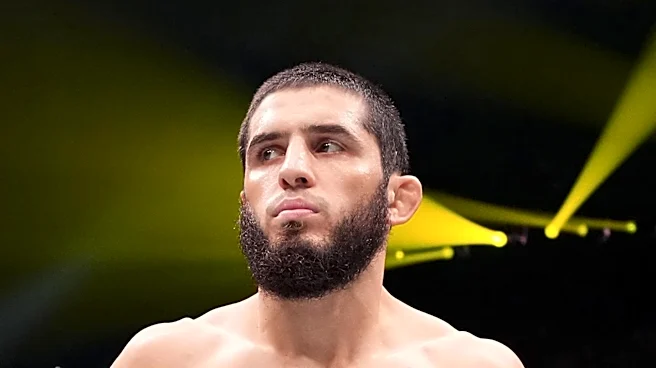
UFC fighter Colby Covington has publicly stated his belief that Islam Makhachev, the current UFC Pound-for-Pound king, would face significant challenges in a traditional wrestling environment. Covington, a former collegiate wrestler, argues that Makhachev's
Sambo-based style, which often involves exposing his back and rolling, would not translate effectively to straight wrestling. He suggests that Makhachev's success in MMA wrestling is partly due to the ability to mix in striking and create takedown threats, elements absent in pure wrestling. Covington has even issued a challenge, expressing his desire to face Makhachev on the mat in a wrestling match, claiming he would 'smoke' him. This assessment comes amidst ongoing discussions about the strengths and weaknesses of various fighting styles within the MMA community.
Why It's Important?
This commentary from Colby Covington highlights a fundamental debate within combat sports regarding the transferability of skills across different disciplines. For MMA fighters, particularly those with a strong grappling background like Makhachev, the distinction between Sambo, freestyle wrestling, and folkstyle wrestling can be crucial. Covington's remarks suggest that while Sambo is highly effective in MMA due to its blend of grappling and striking, its specific techniques might be less dominant in a pure wrestling context. This perspective could influence how fighters train and strategize, potentially leading to more specialized wrestling training for those looking to compete in pure grappling events or to counter opponents with strong traditional wrestling backgrounds. It also fuels rivalries and discussions among fans and analysts about the true 'best grappler' in MMA, considering the nuances of each grappling art.
What's Next?
Following Colby Covington's challenge, the immediate next step would be to see if Islam Makhachev responds to the invitation for a traditional wrestling match. While Makhachev is currently focused on his UFC career and defending his welterweight championship, a high-profile wrestling encounter with Covington could generate significant interest and potentially open new avenues for crossover events in combat sports. Such a match would test Covington's hypothesis about the limitations of Sambo in pure wrestling and could either validate or refute his claims. The outcome could also impact the perception of both fighters' grappling abilities, potentially influencing future matchups and their standing in the sport. The combat sports community will be watching for any official statements or negotiations regarding this potential showdown.
Beyond the Headlines
Beyond the immediate challenge, Covington's comments touch upon the broader evolution of combat sports and the integration of various martial arts. The rise of MMA has seen practitioners from diverse backgrounds, including wrestling, Sambo, Brazilian Jiu-Jitsu, and Muay Thai, adapt their skills for the octagon. This discussion about Makhachev's wrestling highlights the ongoing process of cross-training and the continuous refinement of techniques as fighters seek to gain an edge. It also underscores the cultural differences in grappling styles, with Sambo originating from Russia and having distinct characteristics compared to American collegiate wrestling. The debate could spark further academic and practical exploration into the comparative effectiveness of these grappling arts in different competitive formats, potentially leading to new training methodologies and a deeper understanding of combat sports dynamics.