
What's Happening?
Jensen Huang has been reinstated as the chief executive of Nvidia. This decision follows his admission of multiple extramarital affairs, including one with an individual suspected of spying for Beijing,
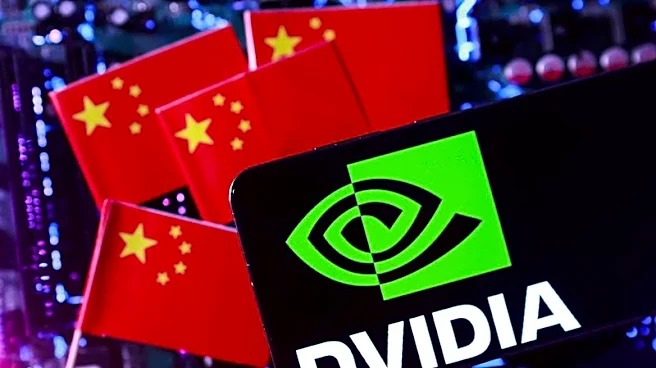
and at least two reported relationships with company employees. His return to leadership occurred after President Trump reportedly lobbied on his behalf. The board's decision also came after Nvidia experienced a significant loss of approximately $491 billion in market value in a single day following Huang's initial ouster. Huang has consistently advocated for the U.S. to maintain its lead in the artificial intelligence sector by encouraging global developers, including those in China, to utilize U.S. technology. Nvidia had sold $2.4 billion worth of U.S.-licensed AI chips to China in the quarter ending in October, representing about 2% of its revenue. However, on November 17, the company announced it would cease shipping chips to China.
Why It's Important?
The reinstatement of Jensen Huang as Nvidia's CEO carries significant implications for the U.S. technology sector and its strategic competition with China in artificial intelligence. Huang's previous advocacy for selling chips to China, despite national security concerns, highlights a tension between commercial interests and geopolitical strategy. His argument that widespread adoption of U.S. technology, even by competitors, strengthens the U.S. position in AI, presents a complex perspective on technological dominance. The recent decision to halt chip shipments to China, however, signals a shift towards stricter adherence to U.S. export controls, potentially impacting Nvidia's revenue streams from a major market. This move could also influence the global AI landscape, potentially accelerating China's efforts to develop indigenous chip technology, while simultaneously safeguarding U.S. technological advantages.
What's Next?
The cessation of Nvidia's chip shipments to China, announced on November 17, will likely have immediate and long-term consequences for both Nvidia and the broader U.S.-China technology relationship. Nvidia will need to adjust its revenue forecasts and market strategies to account for the loss of the Chinese market, which previously contributed a notable portion of its AI chip sales. For China, this move will intensify its drive for technological self-sufficiency in advanced semiconductors, potentially leading to increased investment in domestic research and development. The U.S. government will continue to monitor the effectiveness of these export controls in maintaining its technological edge in AI. The situation could also prompt other U.S. technology companies to re-evaluate their engagement with the Chinese market, potentially leading to a broader decoupling of technology supply chains.
Beyond the Headlines
The controversy surrounding Jensen Huang's personal conduct and his reinstatement raises questions about corporate governance, ethical leadership, and the influence of political figures in corporate decisions, particularly in strategically vital industries. The reported lobbying by President Trump on Huang's behalf, coupled with the substantial market value loss prior to his return, suggests that economic and political considerations can heavily outweigh concerns about executive conduct. This scenario underscores the intricate relationship between national security, economic policy, and corporate leadership in the context of global technological competition. The ongoing U.S.-China AI race, exacerbated by these chip export restrictions, could lead to a more fragmented global technology ecosystem, with potential long-term impacts on innovation, international collaboration, and the global distribution of technological power.