





What's Happening?
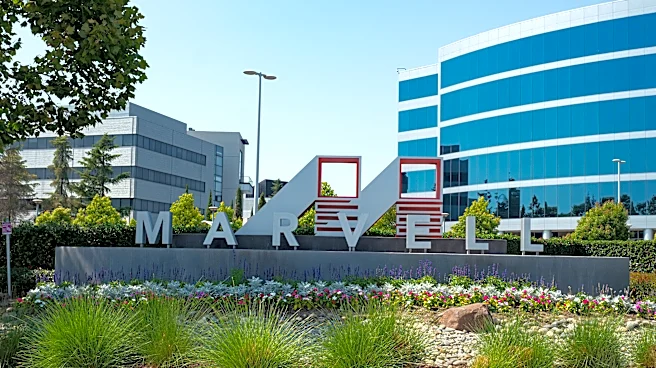
Marvell Technology (NasdaqGS:MRVL) announced new memory and connectivity solutions for Artificial Intelligence (AI) and high-performance computing at Supercomputing 2026. The company introduced what it described as industry-first photonics-based HBM class
memory appliances, designed to alleviate AI memory bottlenecks. These new products align with Marvell's role as a key supplier for AI and high-performance computing infrastructure. In addition to these product launches, Marvell also announced the appointment of three new independent directors to its board. These new directors bring diverse backgrounds in semiconductor technology, finance, and talent strategy, which are expected to support the company's strategic direction and execution, particularly in integrating large programs and managing hyperscaler deals while defending margins.
Why It's Important?
This announcement is significant for the U.S. technology sector, particularly in the context of the rapidly expanding AI market. Marvell Technology's introduction of photonics-based HBM class memory appliances addresses a critical bottleneck in AI and high-performance computing: memory capacity and bandwidth. By easing these constraints, Marvell is enabling more efficient and powerful AI systems, which is crucial for the continued growth and development of AI applications across various industries. The appointment of new directors with expertise in semiconductors, finance, and talent strategy underscores the company's commitment to strengthening its leadership and operational capabilities. This move is vital for navigating the complexities of large-scale integrations, such as the recent Lumentum acquisition, and for maintaining competitiveness against rivals like Broadcom and Advanced Micro Devices in the highly competitive semiconductor market. The success of these solutions could accelerate AI adoption and innovation across U.S. data centers and enterprises.
What's Next?
The practical impact of Marvell's Supercomputing 2026 announcements will be closely monitored as the company provides updates on its multi-year AI connectivity and custom silicon framework. Key areas to watch include progress on CXL memory ramp-up, design wins for its photonic fabric technology, and any changes in guidance related to the Lumentum integration timeline. The new memory and connectivity solutions are expected to influence how Marvell Technology pursues AI data center opportunities, potentially leading to increased market share and revenue in the AI infrastructure segment. The expertise of the newly appointed board members will be crucial in overseeing these strategic initiatives and ensuring effective execution. Investors will be looking for tangible results from these innovations and board enhancements to assess their long-term impact on the company's performance and market position.
Beyond the Headlines
Marvell's focus on photonics-based memory solutions and CXL expansion points to a fundamental shift in how data centers are being architected to handle increasingly demanding AI workloads. The ability to create pod-level optical shared memory and address memory bottlenecks is not just a technical advancement; it represents a strategic move to optimize the economics of AI inference at scale. By enabling higher token throughput and supporting larger models, Marvell is contributing to the infrastructure that will power the next generation of AI applications, from advanced analytics to agentic AI. This technological evolution has broader implications for energy efficiency in data centers, as optimized memory access can reduce the overall power consumption of AI clusters. The strategic collaboration with companies like Penguin Solutions further emphasizes the industry's move towards integrated, full-stack solutions to meet the complex demands of AI, highlighting a trend of deeper partnerships to drive innovation and efficiency.