







What's Happening?
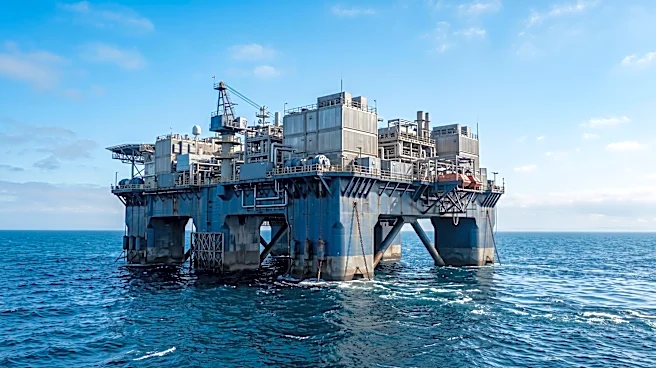
Offshore Data Center LLC has announced a partnership with Houston-based Riverway Group to design and construct offshore platforms. These platforms are specifically engineered to utilize stranded or undervalued natural gas as a power source for data centers
directly at the source. The collaboration aims to provide natural gas producers with a profitable method to monetize gas that is currently uneconomic to develop through conventional means. Art Schroeder, CEO of Offshore Data Center, stated that placing data centers next to the gas supply eliminates the need for pipelines to shore and transmission lines, while also significantly reducing cooling costs. The designs incorporate semisubmersible hull designs from Offshore Data Center partner Horton do Brasil, combined with Riverway’s automated welding and advanced fabrication techniques.
Why It's Important?
This initiative holds significant importance for the U.S. energy and technology sectors. By converting stranded natural gas into power for data centers, the partnership addresses two critical challenges: the monetization of otherwise inaccessible energy resources and the increasing energy demands of data centers, particularly those supporting large-scale AI training. The innovative approach of building data centers offshore and integrating them with gas production facilities could lead to a more efficient and environmentally sound use of natural gas. Furthermore, the use of Riverway’s fabrication methods aims to make construction on the U.S. Gulf Coast cost-competitive with international shipyards, potentially strengthening U.S. maritime manufacturing and creating domestic jobs. This development could also expand AI computing capacity within the U.S. by providing a novel, energy-efficient infrastructure solution.
What's Next?
The partnership will proceed with the design and construction of these specialized offshore platforms. The companies anticipate that this collaboration will not only provide a new revenue stream for gas producers but also enhance the U.S.'s capabilities in maritime manufacturing and domestic energy development. The initial focus will likely be on demonstrating the economic viability and operational efficiency of these platforms. Success in these early stages could lead to broader adoption of the concept, potentially attracting more investment into offshore data center infrastructure. The development could also spur further innovation in energy-efficient data center cooling technologies, particularly with the planned use of closed-loop deep-ocean cooling systems. The long-term impact could include a significant shift in how data centers are powered and located, especially for energy-intensive applications like AI.
Beyond the Headlines
The concept of offshore data centers powered by stranded gas presents a fascinating intersection of energy, technology, and environmental considerations. By tapping into gas resources that are currently uneconomic to bring to market, this project could reduce flaring or reinjection of gas, contributing to a more sustainable energy landscape. The dramatic reduction in cooling costs, which can account for up to 40% of a data center's energy use, highlights a critical area for innovation in the energy-intensive data center industry. This approach also raises questions about the regulatory frameworks for offshore industrial facilities and the potential for similar models to be applied to other remote or underutilized energy sources. The strengthening of U.S. maritime manufacturing through competitive construction methods could have broader economic benefits beyond the immediate scope of data centers, fostering a resurgence in domestic heavy industry.