
What's Happening?
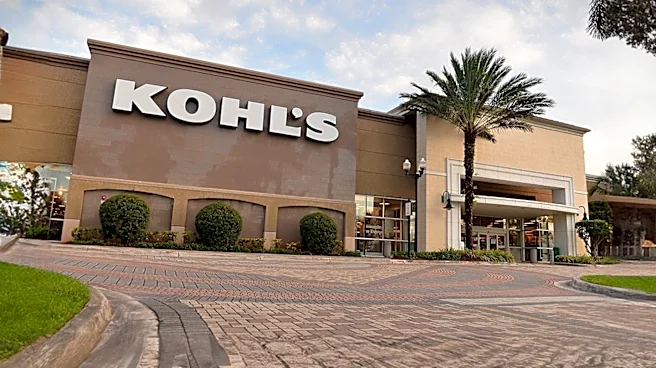
Kohl's Corporation, an omnichannel retailer in the United States, has reported its first positive comparable sales growth in four years, with a 1.2% increase in the third quarter of 2026. This performance
exceeded Wall Street estimates, which had predicted a 0.5% decline. The company's revenue for the quarter reached $3.45 billion, a 1.3% increase from the previous year and above analyst estimates of $3.39 billion. Earnings per share were reported at $1.76, significantly higher than the break-even earnings anticipated by analysts. The reported profit of $254 million for the quarter included a $137 million tax benefit from settled tax examinations, a $61 million gain from property sales, and approximately $45 million in tariff refunds. Despite these one-time benefits, the results indicate a substantial turnaround for Kohl's, which had earned only $8 million in the third quarter of the previous year. The company had experienced 18 consecutive quarters of declining comparable sales prior to this positive report, struggling with inflation and online competition.
Why It's Important?
This positive sales growth for Kohl's is a significant indicator of a potential turnaround for the department store chain, which has faced considerable challenges in recent years. The company's ability to achieve top-line growth after four years of declines suggests that its strategies to combat inflation and online competition may be gaining traction. This performance could instill greater confidence among investors and stakeholders in the broader retail sector, particularly for traditional brick-and-mortar retailers. The improved financial health of Kohl's, as evidenced by its raised full-year outlook, could lead to increased investment in store improvements, digital capabilities, and inventory management, potentially enhancing its competitive position. Furthermore, the positive results from other big box stores like Target, Walmart, and TJX during the same earnings season suggest a broader resilience or recovery in consumer spending within the U.S. retail market, which is crucial for economic stability.
What's Next?
Kohl's anticipates that the positive momentum will continue into the fourth quarter, forecasting comparable sales growth of up to 2%, surpassing analyst expectations of 0.2%. For the full year, the company has revised its sales outlook to be flat to up 0.5%, an improvement from its prior guidance of flat to down 1.5%. This optimistic forecast suggests that Kohl's expects to maintain its growth trajectory through the crucial holiday shopping season. The company's CEO, Michael Bender, expressed continued support for the partnership with Sephora, despite a nearly 2% decline in Sephora shop-in-shops during the quarter. Future developments will likely involve continued efforts to optimize this partnership and other strategic initiatives to sustain growth. The performance of Kohl's in the upcoming quarters will be closely watched by analysts and investors to determine if this turnaround is sustainable or if it represents a temporary uplift.
Beyond the Headlines
The turnaround at Kohl's, even with the aid of one-time financial benefits, highlights the ongoing evolution and challenges within the U.S. retail landscape. The company's struggle with inflation and online competitors for an extended period underscores the intense pressure on traditional department stores to adapt. The fact that the gains were not primarily driven by the Sephora partnership, which saw a slight decline, suggests that Kohl's core retail strategies, potentially involving private-label brands and overall store experience, are contributing to its recovery. This situation prompts a deeper look into how legacy retailers are re-evaluating their business models, integrating omnichannel approaches, and leveraging various revenue streams to remain relevant. The broader context of other big box stores also reporting better-than-expected results indicates a complex interplay of consumer behavior, economic conditions, and strategic retail adjustments that are shaping the future of U.S. commerce.