








What's Happening?
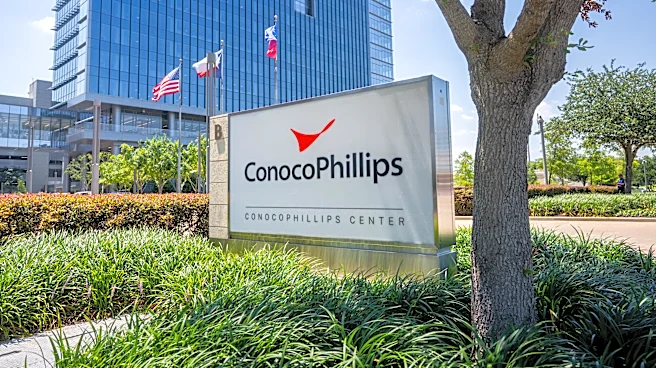
ConocoPhillips announced a significant increase in its third-quarter profit, more than doubling it to $4 billion. The company also raised its quarterly dividend by 11%, from 84 cents to 93 cents per share. This strong financial performance, with adjusted
earnings of $3.27 per share, surpassed Wall Street's estimate of $2.97 per share. The net income saw a substantial jump from $1.7 billion in the same period last year, despite a slight decline in production. The average realized price for ConocoPhillips' oil climbed 32% year-over-year to $61.40 per barrel of oil equivalent, benefiting from Brent crude averaging $89.27 during the quarter. The company returned $3.4 billion to shareholders, including $2.4 billion in share repurchases, and generated $7.2 billion in operating cash flow.
Why It's Important?
ConocoPhillips' robust third-quarter results underscore the significant impact of higher crude oil prices on the profitability of major energy companies. This performance mirrors similar gains reported by other oil majors like ExxonMobil, Chevron, and BP, indicating a strong period for the oil and gas sector. The increased dividend and substantial share repurchases demonstrate the company's commitment to returning value to shareholders, which can attract investors and boost stock performance. For the U.S. economy, a thriving energy sector can contribute to job creation and economic growth, particularly in oil-producing regions. However, the reliance on higher oil prices also highlights the industry's vulnerability to market fluctuations and geopolitical events, such as the Iran war mentioned as a factor in production disruptions.
What's Next?
ConocoPhillips plans to maintain its focus on increasing cash flow rather than dramatically accelerating production. The company projects fourth-quarter output to be between 2.32 million and 2.36 million barrels of oil equivalent per day and aims to increase annual free cash flow by $7 billion by 2029 compared to 2025 levels. The Willow project in Alaska is on track for first oil in early 2029, with module fabrication over 75% complete, which is expected to contribute to future cash flow growth. Additionally, ConocoPhillips is evaluating a potential sale of its Norwegian operations and the Teesside asset in the UK, which could further streamline its portfolio and impact its international footprint.
Beyond the Headlines
The substantial profits reported by ConocoPhillips and other oil majors raise broader discussions about energy policy, corporate responsibility, and the transition to renewable energy. While these companies are currently benefiting from high oil prices, there is increasing pressure from environmental groups and some policymakers to accelerate the shift away from fossil fuels. The company's strategic focus on cash flow and specific projects like Willow in Alaska, alongside potential divestments, reflects a complex balancing act between maximizing current profitability and adapting to long-term energy trends. This situation highlights the ongoing tension between the immediate economic benefits of traditional energy production and the global imperative to address climate change.